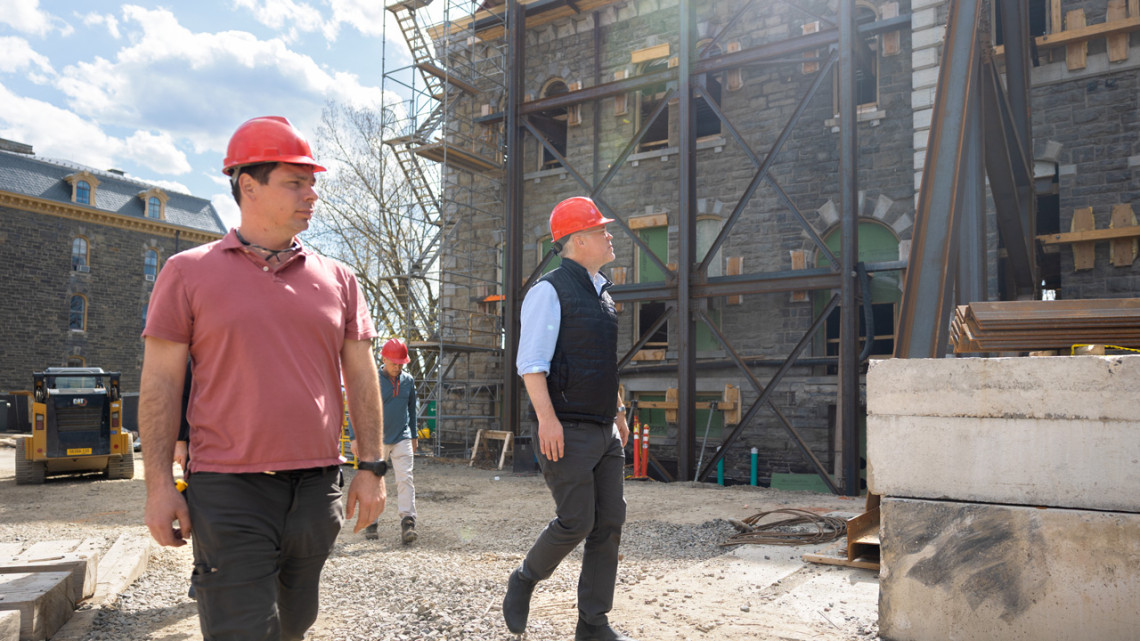
Adam Heisler (left), project manager for Cornell’s Facilities and Campus Services office, leads Peter John Loewen, the Harold Tanner Dean of Arts and Sciences, during a tour of McGraw Hall.
McGraw construction melds modern with historical
By Kathy Hovis
As McGraw Hall, one of the university’s oldest buildings, is rebuilt from the inside out, workers have made several discoveries, and faculty are reusing and studying materials from the building in creative ways in the classroom.
Workers discovered signatures in the stone dating back to 1872; some cast iron columns were stamped with the word “Treman, Valentine and Green,” suggesting the foundry that created them; and pieces of millwork had handwritten names of Cornell shop employees, said Adam Heisler, project manager for Cornell’s Facilities and Campus Services office.
Some of the old lumber in the building was carried to Rand Hall, where architecture classes are studying it for use as engineered lumber. Still more was moved to the Cornell Tree Ring Laboratory in the basement of Goldwin Smith Hall for hands-on work by researchers.

Heisler and Loewen view the inside of the structure. The project has reached the phase where interior rebuilding is underway following demolition.
“We are also saving some architectural elements, such as carved wooden moldings and cast-iron columns, that could be displayed in the entrance of the building in the future,” said Erik Gray, director of facilities for the College of Arts and Sciences (A&S).
The building’s dormers and many of its window frames were salvaged and will be restored and reinstalled, Heisler said.
The McGraw renovation began in 2025 and includes an overhaul of the interior structure and layout, as well as an update to building systems and work to preserve and bolster the exterior façade. Construction is expected to continue through 2027, with reopening planned for 2028.
“McGraw is a symbol of the college’s dedication to the humanities and to the preservation of our history,” said Peter John Loewen, the Harold Tanner Dean of Arts and Sciences. “It also celebrates our commitment to providing modern classrooms, offices and research spaces for students, faculty and staff.”
Named for founding trustee John McGraw, McGraw Hall was designed by architect Archimedes N. Russell and opened in 1872. Built of Ithaca stone, the four-story building was the first on campus to include a tower. Jennie McGraw, daughter of John McGraw, donated the chimes to be placed in the tower, where they stayed until McGraw Tower was built in 1891.
McGraw Hall was the original site of the university library, until Uris Library (then called the University Library) opened in 1891. McGraw Hall also once housed the university museum, the Wilder Brain Collection, the Plaster Cast Collection, the Cornell Lab of Ornithology, the Law School, the Department of Geology, the insect collection and the nation’s first entomology department. The Department of Government was located in McGraw Hall from 1972 to 2003, when it moved to White Hall. Today, McGraw Hall is home to the A&S history and anthropology departments and the archaeology program.
Since nearly the entire inside of the building will be replaced in this renovation, the project required extensive and complex shoring to keep the original stone walls in place, Heisler said. The existing stone walls were carefully sandwiched with engineered lumber to avoid damaging window frames and sills.
The existing framing and decks were mostly wood, with cast iron columns, but the new materials will be noncombustible steel and concrete. Some of the original structure will remain and be reinforced, Heisler said, mostly in the tower and the center wing.
Underpinning foundation work was necessary in both the north and center wings, to allow for the new foundations without undermining the existing stone, he said.
On the exterior of the building, workers used stainless steel rods and grout to stabilize the walls. They’ll also be repointed, Heisler said.
New technology has made the process more efficient and coordinated, Heisler said, including 3D modeling that helped take into account inconsistencies in older stone construction as engineers designed the shoring system.
“We’re creating a modern building within this historic building,” Gray said.
Gray said the project’s construction schedule is on track.
“The first year is where you find hidden unknown things that can cause delays,” he said. “In my mind, these unforeseen problems are now behind us.”
Kathy Hovis is a writer for the College of Arts and Sciences.
Media Contact
Get Cornell news delivered right to your inbox.
Subscribe