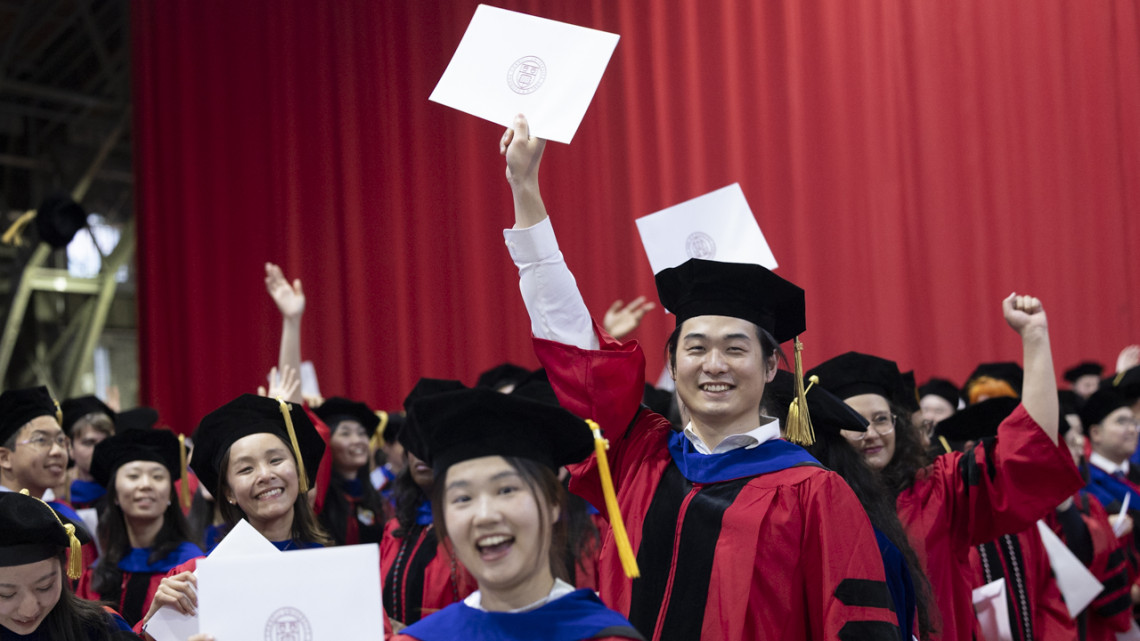
Doctoral candidates celebrate with their degrees during the Ph.D. Recognition Ceremony, held May 22 in Barton Hall.
Ph.D. graduates encouraged to carry ‘culture of collaboration’ into the world
By David Nutt, Cornell Chronicle
On the eve of Commencement, doctoral candidates in the Class of 2026 received one last lesson – three, in fact – courtesy of President Michael I. Kotlikoff.
The process of earning a Ph.D. and becoming an expert in their field is only the beginning, he said. They will need to reinvent themselves – more than once.
“We no longer live in a world where people train for one job, with the expectation of doing the same thing for the rest of their careers,” Kotlikoff said during the Ph.D. Recognition Ceremony, held May 22 in Barton Hall.
At the same time, he offered a strong vote of confidence.

The candidates thanked the friends and family in attendance who had supported their academic journey through encouragement, sacrifice and belief.
“Your training here,” he said, “has prepared you exceptionally well for an unknowable future – with the intellectual courage and the flexibility of mind to try new things, the intellectual rigor to evaluate new situations carefully and the skills particular to your own areas of expertise.”
The hundreds of doctoral candidates, who jubilantly entered the ceremony in their flowing regalia amid a sea of camera phones and thunderous applause, were welcomed by Thomas A. Lewis, dean of the Graduate School and vice provost for graduate education.
“Earning a doctorate is exceptionally challenging,” Lewis said. “If your experience was anything like mine, there were difficult moments, moments when you wondered whether you wanted to continue. There were hypotheses that did not pan out, relationship dynamics that weren’t what you expected. You are here today, not because the path was easy or obvious. You are here today because you persisted when it was not.”
Provost Kavita Bala then congratulated the candidates and asked them to stand, turn around and thank the friends and family in attendance who had supported their academic journey through encouragement, sacrifice and belief. Speaking on behalf of the university faculty and staff, Bala said it was an honor and privilege to know and work alongside the candidates.

The candidates were urged to be humble and work toward making the world a better place.
“We are proud of what you have accomplished, and we are eager to see the work you will do next, which will shape our future in ways we cannot predict,” she said.
Faculty remarks were delivered by Julia Dshemuchadse, assistant professor of materials science and engineering in the Cornell Duffield College of Engineering. Dshemuchadse urged the candidates to be humble and work toward making the world a better place.
“Be brave and keep doing hard things,” she said. “Do not shy away from difficulty, from ambiguity, or from contradiction. Subtlety and nuance often carry the potential for our deepest insights and our most important actions.”
The candidates then lined up and crossed the stage to shake Bala’s hand and receive a certificate from Lewis.
Another lesson from Kotlikoff concerned the candidates’ printed and bound dissertations – what he referred to, in the words of a former student, as their “black books of triumph.”
Dissertations are a demonstration of each candidate’s intellectual capacity, their mastery of their chosen topic and their ability to contribute, at the highest level, to their field, he said.
“Whatever lies ahead, I want all of you to remember the triumph that lies inside them,” Kotlikoff said. “And when you take on a new project, something you’ve never done before – perhaps something no one has ever done before – think back to your black book of triumph. If you can do that, you can do anything.”

After crossing the stage to shake Provost Kavita Bala’s hand, the candidates received a certificate from Thomas A. Lewis, dean of the Graduate School and vice provost for graduate education.
Kotlikoff capped his lesson by citing Cornell’s unique culture of collaboration – “the secret ingredient, the special sauce, that has driven so much of Cornell’s creativity and productivity and distinction over the past 161 years.”
“It’s a personal and institutional ethos,” he said, “that goes hand in hand with all of our institutional values at Cornell – with our academic excellence and with our foundational commitment to being an institution where any person can find instruction in any study. … It is a culture I hope all of you bring with you, wherever you go from here.”
Media Contact
Get Cornell news delivered right to your inbox.
Subscribe