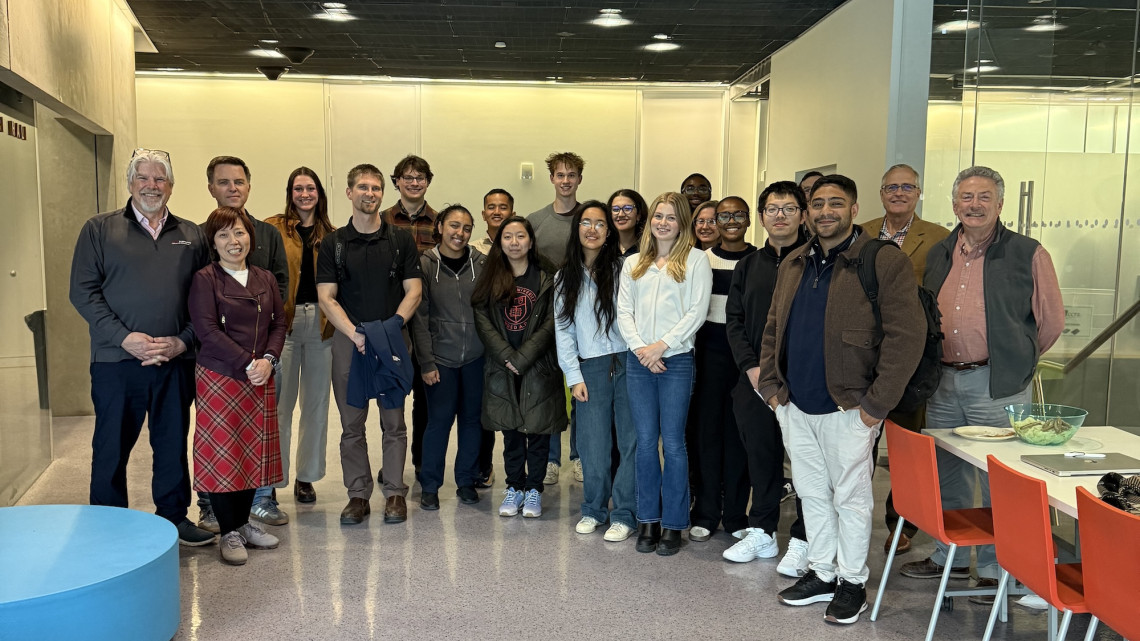
Student and staff participants of the Innovation Collaborative final presentations, May 1 in Gates Hall, in which Cornell students presented commercialization strategies for technologies developed by engineering faculty.
News directly from Cornell's colleges and centers
Students pitch market potential for engineering inventions
By Syl Kacapyr
From advanced microscopes that peer deep into living tissue to software that maps transportation emissions, Cornell students presented commercialization strategies for technologies developed by engineering faculty during the Innovation Collaborative final presentations on May 1 in Gates Hall.
The event, hosted by the Cornell Duffield College of Engineering’s Office of External Collaboration and Innovation, was the culmination of two courses focused on technology-to-market analysis and commercialization strategy. Student teams worked directly with faculty and entrepreneurs in residence mentors throughout the courses before presenting their recommendations to a panel of judges.
“This class is somewhat unique within the college,” said Patrick Govang, senior director of the Office of External Collaboration and Innovation, who noted in his opening remarks that student teams are given “actual intellectual property from the research enterprise within the college and their analyses may help inform future commercialization efforts.”
Six teams evaluated technologies spanning computing, materials, environment, and biomedical imaging, and developed proposals to bring them from the lab to market. The panel evaluated each team not on the recommended outcome, but rather the critical thinking the team applied to arrive at their recommendations.
The winning team analyzed the market opportunities for a customized two-photon fluorescence microscope – a tool used for high-resolution tissue imaging and outfitted for laboratories studying pathogens and infectious agents. Their presentation identified a clear need in fundamental biomedical research, but after extensive market analysis the team concluded there was not yet a strong commercial pathway for advancing the technology to market.
“It was a very practical experience that would be hard to get in traditional courses,” said team member Donny Christian, an M.Eng. student studying biological and environmental engineering. “Undergoing this process showed me the amount of creative thinking and careful analysis required to make sounds decision about when to pursue an opportunity and when to manage risk.”
Throughout the course and during their presentations, students were tasked with going beyond technical explanations to define customers, assess competition and recommend realistic paths forward.
One team examining an additive manufacturing process designed to make brittle ceramic more durable refined its strategy over the semester. Initially focused on selling directly to manufacturers, the group pivoted toward targeting large aerospace and drilling companies – the end users most affected by material failure – and recommended licensing the process directly to their research and development labs.
Another team evaluating transportation emissions modeling software recommended expanding beyond its original government use case. In addition to municipal planning organizations, the group identified opportunities in logistics and academic research, where faster and more flexible emissions analysis could provide immediate value.
Other projects included a memory retrieval acceleration system for artificial intelligence, a nanoparticle-based thruster for satellites and a new method for growing wide-bandgap semiconductors, each highlighting different challenges in translating research into viable products.
Judges from the Cornell Center for Technology Licensing, the Cornell Center for Regional Economic Advancement, and Toyota Materials Handling North America pressed teams on feasibility, market demand and return on investment – mirroring the kinds of questions innovators face outside the classroom.
The courses reflect a broader emphasis within Duffield Engineering on experiential learning, giving students the opportunity to think broadly in an unstructured way and engage directly with the complexities of commercialization. By working at the intersection of engineering, business and intellectual property, participants gain insight into how new technologies move from discovery toward real-world impact.
“This class added a new dimension to how I think about my future career,” said Remy Vearil ’26. “Throughout this course I found myself connecting with the sense of ownership that our inventors had over their work. That feeling of building something up and caring deeply about where it goes made me realize that what I want is to be in the room where things are still undefined, where the technology is early and the possibilities are still a question.”
The Office of External Collaboration and Innovation will incorporate student recommendations into decisions about potential seed funding for the Cornell technologies examined by the student teams.
The Innovation Collaborative was supported by Ron Kermisch ’88; Rob Cañizares ’71, MBA ’74, and Gail Cañizares; and engineering alumni from the Class of 2000.
Media Contact
Get Cornell news delivered right to your inbox.
Subscribe