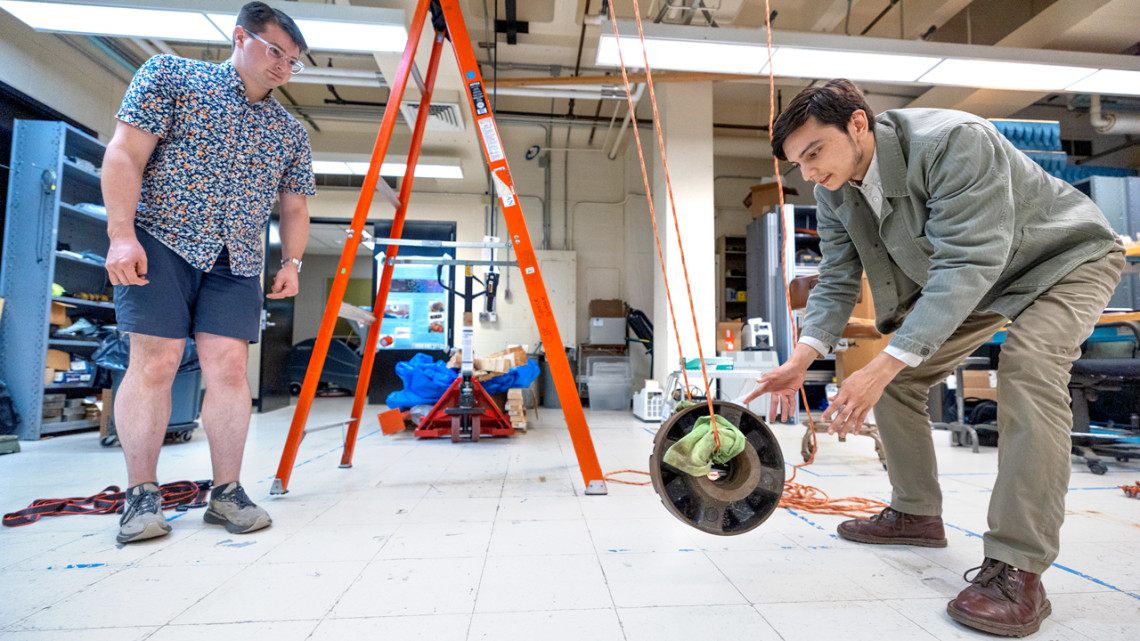
At right, Warrior-Scholar Project student Abel Rodriguez prepares for presentations in the Space Sciences Building with instructor Baird Bankovic.
Academic ‘boot camp’ helps veterans build college confidence
By James Dean, Cornell Chronicle
As a teenager, Colby Morse skipped high school often and rarely studied or did homework. College felt like a foreign concept.
That’s all changed after three years of experience as an Army signals analyst and success in night classes at community college in Maryland. Invigorated by a new interest in computer science, he enrolled in an academic “boot camp” hosted at Cornell June 20-27, offered by the Warrior-Scholar Project (WSP), a nonprofit that helps active-duty and veteran enlisted personnel pursue higher education.
Morse, now 20, found himself at a whiteboard in the Space Sciences Building late one evening working through a problem set with peers in the program’s science, technology, engineering and math cohort – and enjoying it. He felt nearly giddy after a Cornell astronomy professor’s lecture about the search for life beyond Earth.

Dressed in clean-room suits, the Warrior-Scholar Project’s STEM boot camp cohort toured the Cornell NanoScale Science and Technology Facility.
“It clicked,” he said. “As I was going through these problems, I was also having a really fun time. I thought, my gosh, this college thing, it’s kind of exciting. And since coming here, I’ve gotten a big confidence boost.”
Morse was one of 18 boot camp participants, including 10 studying STEM topics and eight in a college readiness cohort focused on American democracy. Representing the Army, Air Force, Navy and Marines, they ranged in age from 20 to 42, including active-duty personnel, reservists and veterans.
More than 115,000 veterans transition out of the military each year, according to WSP, with many turning to higher education as a pathway to new careers. Often having been out of school for years, some find the transition challenging academically and culturally.
WSP says its boot camps on campuses across the country – Cornell has been a host since 2015 – simulate an intense finals week, involving more than 75 academic hours with staff tutors and mentors and university faculty. Their goal: help veterans build skills and confidence and expose them to campus life and opportunities, surrounded by a network of peers with similar experiences and ambitions.
In a college readiness class, Glenn Altschuler, the Thomas and Dorothy Litwin Professor of American Studies Emeritus in the College of Arts and Sciences (A&S), discussed with students whether the Declaration of Independence’s “all men are created equal” claim envisioned economic or political equality, and the implications for democracy of growing wealth gaps in the U.S. Altschuler emphasized the importance of defining terms such as “democracy” and “equality” when critically reading passages from Danielle Allen’s book “Our Declaration” and Alexis de Toqueville’s political treatise “Democracy in America.”
“To the extent that you are rigorous in textual analysis and in the follow-up about how to interpret text, you will be immensely successful, whatever it is that you might want to do,” said Altschuler, former dean of the School of Continuing Education. “A good college education will help you do that.”
In a STEM lecture, Shami Chatterjee, associate professor in the Department of Astronomy (A&S), discussed the Fermi paradox: If evidence suggests life should be abundant across the universe, where is everyone? So far, NASA’s Kepler space telescope mission has at least proven that planets are common, including large numbers orbiting within their stars’ habitable zones.
“Almost every other star statistically has planets,” Chatterjee said. “It’s really extraordinary how that has changed our understanding of our place in the galaxy.”
Boot camp participants received college admissions advice from a panel including Kyle Downey, a former Army reservist who leads Cornell’s undergraduate admissions for veteran and ROTC students; Hanh Dinh, undergraduate student veteran program director, a Marine veteran, first-generation college graduate and WSP alum; and Sara Horvath ’27, an undergraduate veteran in the College of Agriculture and Life Sciences.

Warrior-Scholar Project student PJ Zieniuk, left, works with writing instructor Brehan Brady at a college readiness academic boot camp in Robert Purcell Community Center.
Downey said military students typically bring traits that are valued on campus: motivation, grit and wisdom gained from real-world experience working with people from different backgrounds.
“You’re doing this because you want to and have goals, not because your parents or someone else is pushing you,” he said. “You have that drive, maturity and work ethic – all those intangibles to make it happen.”
WSP participant Cihan Cagler’s service as a member of the New York Air National Guard has included supporting New York state prisons affected by a corrections officer strike. Though he hopes to pursue a humanities degree and possibly law school, he enrolled in WSP’s STEM boot camp with a military ethos of getting more comfortable outside his comfort zone.
“It’s nice to come somewhere where people want to pursue education, where you can really be yourself and pursue your interests,” said Cagler, a 21-year-old from Brooklyn. “A lot of veterans struggle with imposter syndrome, with feeling out of place, especially in higher education and on a prestigious campus. So being here is a big confidence builder. It’s just as much psychological as it is practical.”
Marine veteran Tifany Martinez, also from New York City, remembers as a younger person being called naive for wanting a residential college experience. She eventually earned an undergraduate degree and led a her college’s veterans club, and this fall will begin pursuing a master’s degree in information science at Cornell.
“When you first get out and you’re going to school, you have way more questions than answers,” she said. “I’ve learned so much since I’ve been out of the military, but a lot of that was finding my own path on my own, and I realize now it didn’t have to be that way.”
Yu Chen, 42, a Navy hospital corpsman in Connecticut, enlisted nearly five years ago. In that decision, and now preparing for a potential college career, she said she hopes to set an example for her teenage daughter, who is nearing college age.
“I want to be a good example for her that no matter what your status is right now, you always can change,” she said. “I can feel myself growing during this process. It makes me feel like I can do it. I’m proud of myself that I made it.”
Media Contact
Get Cornell news delivered right to your inbox.
Subscribe