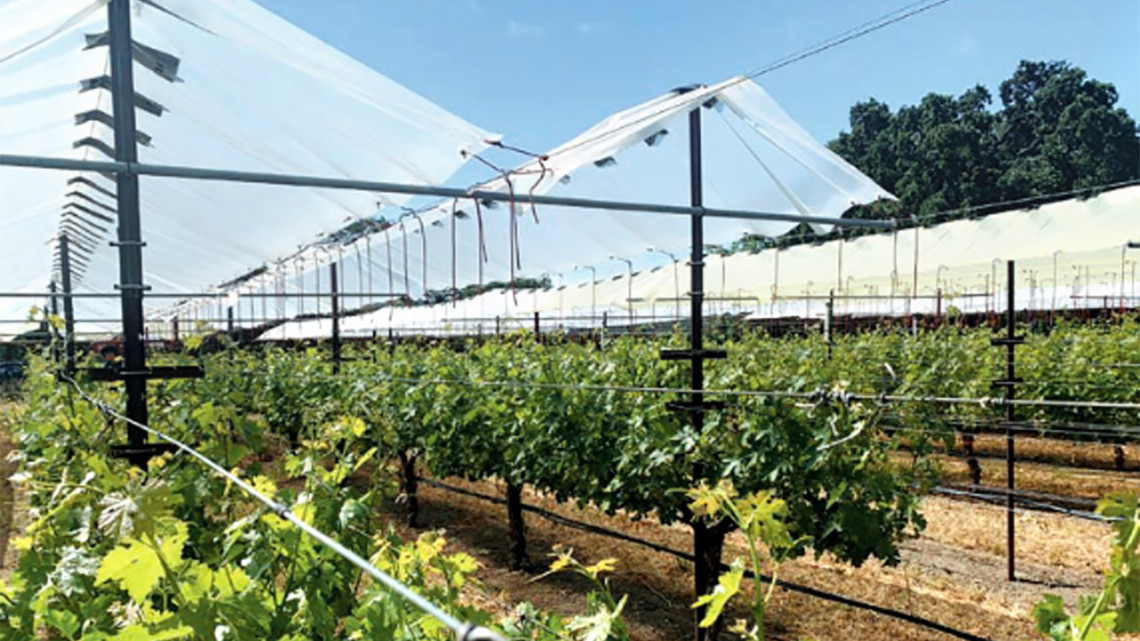
For marked climate changes, technologies like new shade cloth pay off to shield Napa’s premium grapes like cabernet sauvignon.
Climate change and wine grapes: Go, stay or change?
By Laura Reiley, Cornell Chronicle
On a hot afternoon in California wine country, the sun can do more than warm a vineyard. It can scorch it.
When temperatures climb above 100 degrees Fahrenheit, grape clusters can heat to nearly 140 degrees in direct sunlight. The berries shrivel. Their color compounds break down. Yields drop. And for growers who have invested millions in land and vines expected to produce for decades, a single brutal heat wave can ripple through the balance sheet for years.
Climate change is making those calculations harder. Around the world, wine regions are confronting the same question: How do you keep making great wine when the climate that once defined your “terroir” is shifting?
A new interdisciplinary study by Cornell researchers tries to answer that question not just with agronomy, but with economics. Should growers keep growing the grapes they’ve historically grown, aided by new technologies? Or should they move their growing to cooler climes? Or maybe pivot to more heat- and drought-resistant grape varieties?
The researchers’ conclusion: It depends. The smartest strategy hinges on how extreme the future climate becomes – and how willing wine drinkers are to embrace change.
Bradley Rickard, professor in the Dyson School of Applied Economics and Management in the SC Johnson College of Business; Alex Susskind, The Banfi Vintners Professor of Wine Education and Management in the Nolan School of Hotel Administration in the SC Johnson College of Business; and Justine E. Vanden Heuvel, professor in the horticulture section of the School of Integrative Plant Science in the College of Agriculture and Life Sciences, collaborated to examine three strategies wine grape growers might use to cope with rising heat: shielding grapes from the sun with shade cloth, switching to more heat-tolerant grape varieties, or moving vineyards to cooler regions.
“Wine grapes are unique in that people are very attached to certain cultivars and the sense of the place where they come from,” Vanden Heuvel said. “That’s not true with most other crops. Do you care where your radish comes from?”
Global temperatures have already risen more than 1 degree Celsius since preindustrial times, and vineyards are feeling the effects. Grapevines are sensitive to temperature at several stages of growth. At around 86 degrees F, photosynthesis begins to falter. Around 95 degrees F, compounds that give red wine its color start to degrade. Above 104, cells can suffer outright damage.
For iconic grapes like cabernet sauvignon, prolonged heat waves can shrink harvests and alter flavor.
That’s a particularly thorny problem in prestigious regions like Napa County, where cabernet commands some of the highest grape prices in the world.
Consumers want to see it right on the label. Napa? Check. Cab sauv? There it is.
“Wine around the world has this tradition of having on the label the name of the grape and where it came from,” said Rickard. “Even inexpensive box and jug wine has the name of grape and place of origin on the front, and even among less-sophisticated consumers, there’s recognition of that. This paper is trying to understand if changing anything about that formula – whether the grape, the location or the production method – can affect what consumers are willing to pay.”
To understand the financial stakes, the researchers built a detailed economic model of a vineyard’s life cycle. Establishing a vineyard is expensive: planting vines, installing trellises and irrigation, and waiting years for the first full harvest. Once planted, a vineyard might produce grapes for 30 years.
The team calculated the long-term financial return of three climate-adaptation strategies.
The first option was technology: installing shade cloth above vines to block direct sunlight. Studies show this can lower grape temperatures by several degrees, reducing sunburn and protecting quality during heat waves. But it also adds substantial costs, Vanden Heuvel said, including installation and replacement every several years.
The second option was changing the grape itself. Instead of cabernet sauvignon, growers could plant varieties that tolerate hotter climates, such as carignane. These grapes often yield more fruit in hot conditions, though they may fetch lower prices.
The third option was migration. Rather than changing grapes, a grower might move production to a cooler nearby region such as Lake County, where temperatures historically run lower than in Napa.
Because wine markets depend heavily on consumer perception, the researchers also surveyed more than 300 American wine drinkers.
Participants were shown hypothetical wine labels reflecting the three strategies and asked how much they would be willing to pay.
The results were somewhat encouraging for growers experimenting with climate adaptations. When consumers were told that a wine used shade technology to protect grapes from extreme heat, they were willing to pay about 17% more on average. Wines made from a different grape variety received a roughly 12% premium when consumers learned the change helped vineyards adapt to climate stress.
“It is safe to say that consumers are beginning to understand how climate change is affecting wine production,” Susskind said. “And they appear to be willing to pay a price premium as wine makers adjust to the new their normal.”
Even wines produced in a new region received a modest boost in perceived value.
But those premiums were likely temporary. The researchers assumed they might last only a few years before fading as novelty wore off.
When the team ran the economic simulations, the “best” strategy shifted depending on how severe future heat waves became.
If climate change brings only mild temperature increases, sticking with traditional cabernet sauvignon in Napa remains the most profitable approach. Under moderate heat stress, however, installing shade cloth can pay off, protecting yields enough to justify the added cost. And in the most extreme scenarios, switching to a heat-tolerant grape variety produced the strongest financial return.
In other words, adaptation is not one decision but an evolving set of tradeoffs. The Cornell researchers say their framework could help vineyard owners evaluate those decisions with clearer financial expectations.
Media Contact
Adam Allington
Get Cornell news delivered right to your inbox.
Subscribe
