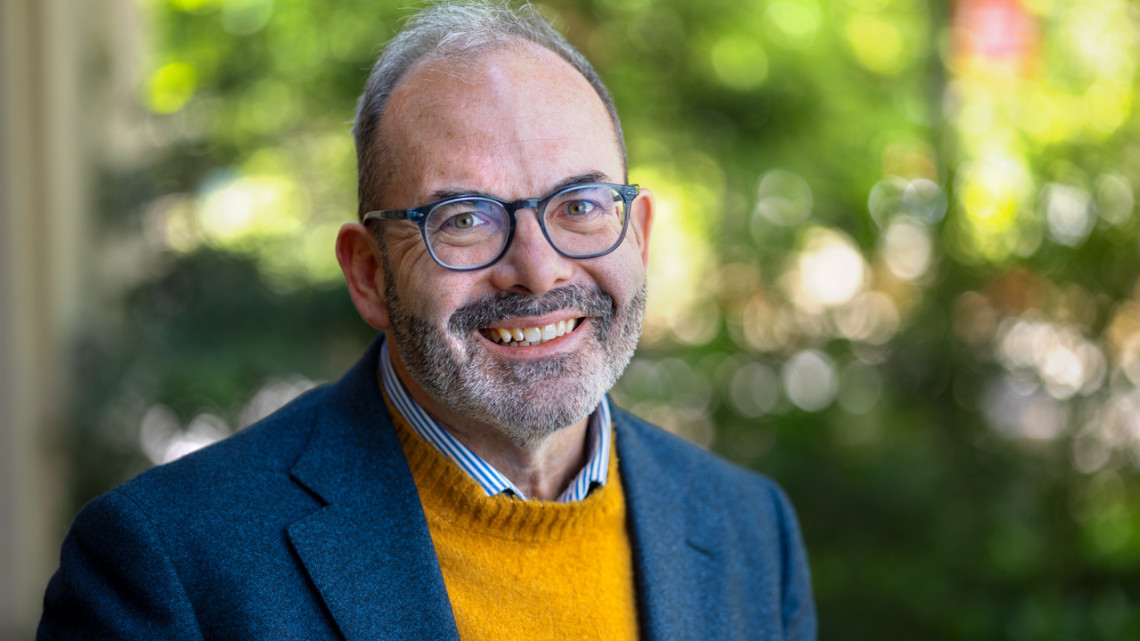
Matt Marx has been named vice provost for entrepreneurship, innovation and external engagement.
Matt Marx named vice provost for entrepreneurship, innovation and external engagement
By Susan Kelley, Cornell Chronicle
Matt Marx, the Bruce F. Failing, Sr. Professor of Entrepreneurship and Innovation in the Cornell SC Johnson College of Business, has been named vice provost for entrepreneurship, innovation and external engagement – a newly reimagined position intended to coordinate and bolster Cornell’s efforts in these critical areas.
Marx will establish the new Cornell Center for Entrepreneurship and Innovation, which will bring together related programs, incubators and centers, with the aim of boosting university efforts to commercialize breakthrough scientific discoveries. As founding director of the new center, Marx will oversee Entrepreneurship at Cornell, the Center for Regional Economic Advancement, the Praxis Center for Venture Development, the Center for Life Science Ventures and the Center for Technology Licensing offices serving Ithaca, Cornell Tech and Weill Cornell Medicine. He begins July 1.
“This position is crucial to Cornell’s enhanced efforts to support entrepreneurship, innovation, technology transfer and external partnerships with corporations, and the new center will accelerate that mission,” Provost Kavita Bala said. “Matt’s extensive experience, research and leadership in entrepreneurship demonstrate he is the right person to help us expand on our existing work.”
Krystyn Van Vliet, vice president for innovation and external engagement strategy since March 2025, will step down from her leadership role while remaining on the Cornell faculty, where she is a professor jointly in the Department of Materials Science and Engineering and the Meinig School of Biomedical Engineering in the Cornell Duffield College of Engineering. A materials scientist, biomedical engineer and entrepreneur, Van Vliet served as vice president for research and innovation from February 2023 to February 2025, and as vice president for innovation and external engagement strategy from March 2025 to June 2026.
“I’m grateful to Krystyn for her service to the university at a challenging time,” Bala said. “She was instrumental in establishing Cornell’s significant role in Empire AI, an exciting collaboration that will reap benefits for years to come. Her work with several new partnerships including NORDTECH – the Northeast Regional Defense Technology Hub – has also been incredibly valuable.”
Marx, who will operate within the Division of Research and Innovation, will report to Bala.
“I’m honored to have been asked by the provost to take on this new role,” said Marx, noting Cornell’s history of entrepreneurship that started with founder Ezra Cornell’s technological innovation advancing the efficacy of the telegraph.
“I’m excited by the enormous potential from our amazing faculty and students, who publish more than 10,000 articles per year containing technological advances and inventions that can positively impact society through new ventures,” Marx said. “I’m especially excited to collaborate with Cornell Tech, whose Runway Startups Postdoc Program serves as a model for the entire university in commercializing research.”
Dr. Gary Koretzky ’78, vice provost for research, will continue to oversee research for the Ithaca, AgriTech and Cornell Tech campuses and will coordinate with Marx across Research and Innovation. “I am thrilled to be working with Matt," Koretzky said. “I am certain that his skills will help us move the needle in important and impactful ways.”
Marx said he will use AI and machine learning to take a proactive, data-driven approach to commercialization and venture development. He aims to employ AI to help students and faculty navigate Cornell’s complex entrepreneurship ecosystem of courses and co-curricular programs. AI can help identify hidden commercialization opportunities among Cornell research, and match Cornell entrepreneurs with potential co-founders, employees, investors, alumni advisers and corporate partners, he said.
He also plans to measure Cornell’s entrepreneurial impact at scale, to better understand which initiatives are making a difference and where more investments are needed.
“The aim is to make it easier to create new companies that leverage Cornell’s innovative research to solve the world’s most pressing problems, bolstering programs to incubate and accelerate ventures across all of our campuses,” Marx said.
Marx is an engineer and executive with six patents and a decade of experience at high-tech startups specializing in voice recognition. He is also an academic researcher who studies entrepreneurship and innovation.
From 1999 to 2004, he was vice president of solutions delivery at Tellme Networks, a speech recognition services startup handling 1 billion calls per year; Microsoft acquired Tellme Networks in 2007 for $800 million. From 1994-99, Marx was also director of customer solutions for SpeechWorks International, which completed an initial public offering in 2000.
Prior to joining Cornell, he was an associate professor at the Massachusetts Institute of Technology’s (MIT) Sloan School of Management and Boston University’s Questrom School of Business.
Marx joined Cornell’s faculty in 2021 as professor of management and organizations in the Dyson School of Applied Economics and Management, part of the SC Johnson College, and as the faculty director of Entrepreneurship at Cornell. He is currently department editor for entrepreneurship and innovation at the journal Management Science and has been a research associate at the National Bureau of Economic Research since 2021.
Marx earned a B.S. degree in symbolic systems from Stanford in 1993, and a M.S. in media arts and sciences from MIT in 1995. At Harvard University, he earned an MBA in 2005 and a Ph.D. in business administration in 2009.
Media Contact
Get Cornell news delivered right to your inbox.
Subscribe