News directly from Cornell's colleges and centers
Researchers-turned-inventors recognized at Bearers of Innovation celebration
By Veronica Buezo Talavera
Many scientific discoveries have the potential to reach beyond the lab and into the market. Cornell University researchers are contributing to a body of knowledge that advances their fields and are increasingly translating those discoveries into real-world applications.
On May 20, Cornell’s Center for Technology Licensing (CTL) brought together inventors from across colleges and campuses in Ithaca and at Weill Cornell Medicine in New York City for Bearers of Innovation: A One Cornell Celebration. The event recognized 82 lead inventors who submitted their first invention disclosure to CTL in fiscal year 2024 or fiscal year 2025, and 306 inventors whose technologies were licensed or optioned during that same period.
"Technology commercialization matters," said Alice Li, executive director of CTL, during her welcome. "It's more important than ever that we move our work beyond the labs."
Today, more than 1,000 Cornell technologies are licensed to over 500 industry partners worldwide. In the last fiscal year, Cornell launched 20 new technology ventures — a new institutional record. Across the past five years, the overall technology startup portfolio has raised over $2.4 billion in funding.
In the United States, May is National Inventors Month, a fitting backdrop for an event recognizing researchers on the technology commercialization journey — which begins with the invention disclosure to CTL — starting the conversation about the real-world potential of their discovery and what the right path forward might look like.
"These inventors are leading not only with their research, but with their commitment to purposeful discovery," said Lisa Placanica, senior managing director of CTL at Weill Cornell Medicine.
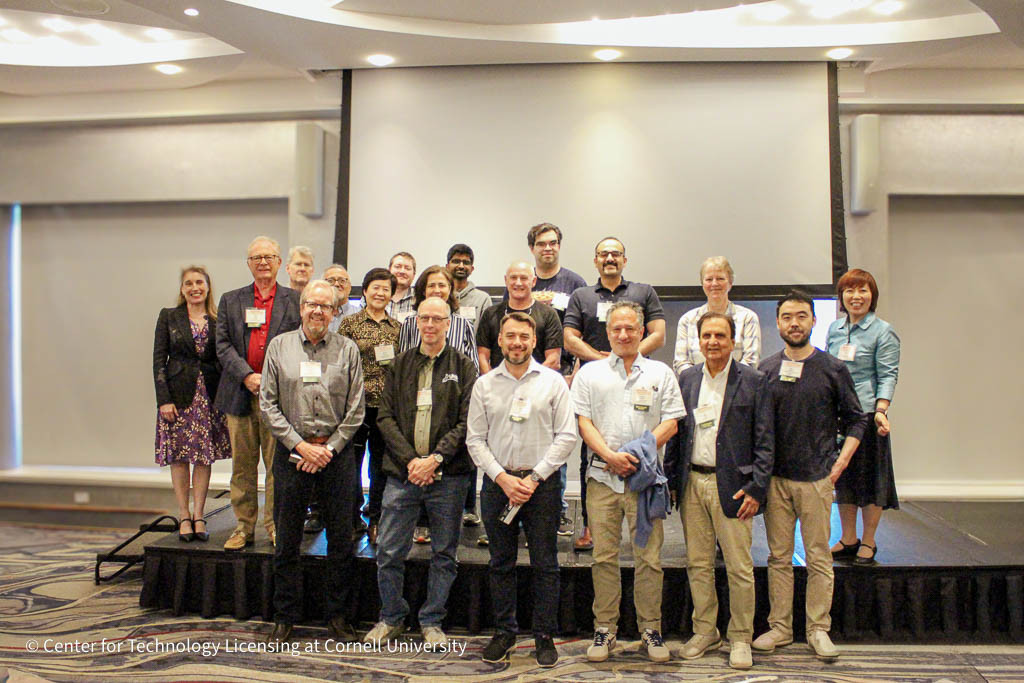
Inventors based in Ithaca attend Bearers of Innovation: A One Cornell Celebration on May 20.
Krystyn Van Vliet, vice president for innovation and external engagement strategy at Cornell Research and Innovation, highlighted the range of technologies the university has brought to market, from plant varieties developed decades ago to advanced computer chips today noting the breadth and range of ideas Cornell has built over the years.
This year's honorees reflected that breadth. Inventors recognized came from across Cornell's colleges, including the Duffield College of Engineering, the College of Veterinary Medicine, the College of Agriculture and Life Sciences, the College of Human Ecology, the Ann S. Bowers College of Computing and Information Science, and Weill Cornell Medicine, among others.
Two journeys, one stage
Cornell inventors and founders Robbert Van Renesse, a professor of computer science, and Hakim Weatherspoon, a professor of computer science and associate dean at Cornell Bowers, delivered the keynote from Ithaca, streamed live to New York City. Together, they walked through the decade-long journey that led to Exostellar, a startup built on technology developed in their labs for improving cloud computing efficiency. The company was acquired by Qualcomm earlier this year.
The story was not a straight line. Through their participation in the NSF I-Corps program, which included more than 90 customer interviews, Weatherspoon and Van Renesse, along with co-founder Zhiming Shen, Ph.D. ’17, refined their understanding of the market and discovered the real demand: helping companies reduce what they were paying for underutilized cloud resources.
"We went through many pivots until we found something that people were actually interested in," Van Renesse said.
"You don't have to wait for the perfect solution," Weatherspoon added. "You probably don't have it to begin with. Instead, you have to be agile." He then explained that commercialization is not separate from research; it is an extension of it. "You have to talk to the market to figure out what people will actually pay for, what they need and what they're missing."
The acquisition by Qualcomm — what Weatherspoon called "Chapter 8" of the story — was only possible because of everything that came before it: the disclosure, the prototypes, the I-Corps training, the SBIR grants, the local investors, the mentors, the business incubation. "It actually started with the invention," he said. "The acquisition is Chapter 8. Chapters 1 through 7 are what got us there."

Inventors based in New York City attend Bearers of Innovation: A One Cornell Celebration on May 20.
In New York City, Jason Spector, M.D., chief of the Division of Plastic and Reconstructive Surgery at Weill Cornell Medicine and co-founder of Fesarius Therapeutics, joined Lisa Placanica for a fireside chat streamed live to Ithaca. His company's first product, DermiSphere — a collagen-based device for wound healing that received FDA 510(k) clearance in 2025 — started not with a business plan but with a frustration he repeatedly encountered in the operating room.
Standard wound healing devices were too slow. Bacteria often won the race against the body's own regenerative process. Spector's lab, working with biomechanical engineers, found a design approach that changed that. "If you can make the vascularization happen faster," Spector said, "you save the patient time, you save them surgeries, you change their recovery and, of course, their lives."
Spector was direct about what it takes to get started. When asked what a researcher should do first in commercialization, he provided three recommendations: be discreet with the idea early on, build your network, and reach out to CTL. "CTL would be one of the first places you want to go," Spector said.
Cornell's innovation ecosystem at scale
The event was not only a celebration of individual inventors. It was a recognition of the ecosystem that makes the journey possible — from business incubators and accelerators to mentors, department chairs, industry partners, and the CTL team itself. "Not every university has that," Van Vliet said. "It's built here specifically for Cornell."
According to the National Academy of Inventors, Cornell ranked No. 20 among the top 100 U.S. universities for utility patents granted in calendar year 2025, with 103 patents, placing it among the most prolific research universities in the country.
These are not abstract numbers. They represent technologies moving through the commercialization journey. Behind every licensed technology, every startup, every product reaching a patient or a market, there is a researcher who decided their discovery was worth pursuing and the support along the way.
Media Contact
Get Cornell news delivered right to your inbox.
Subscribe