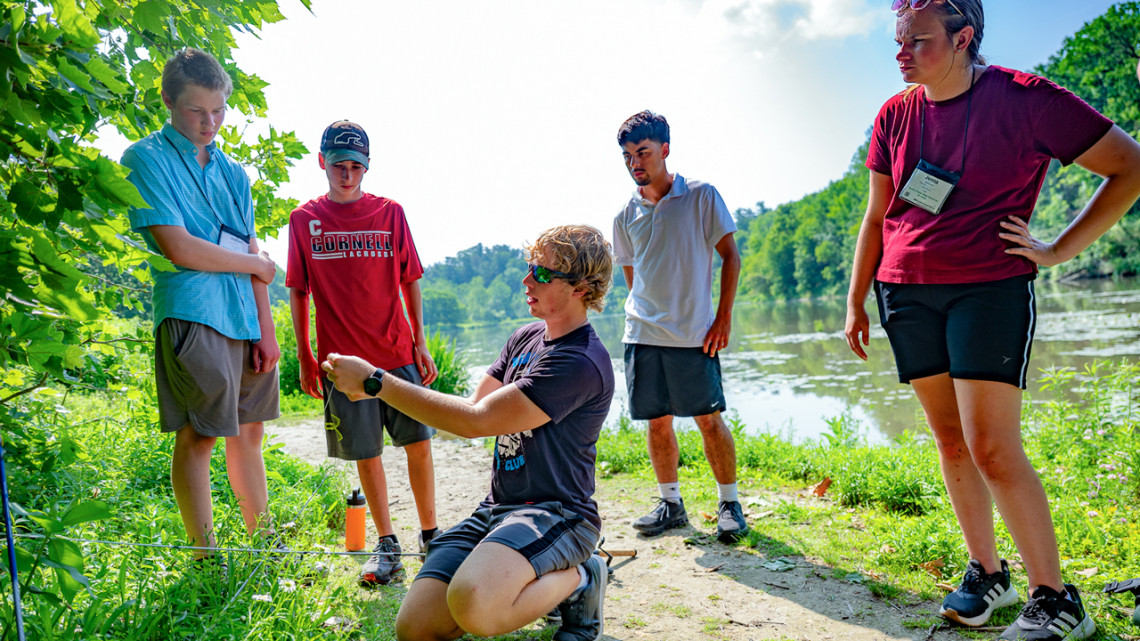
4-H’ers participate in the World of Water, where they conducted research across campus, including invasive species sampling and fishing in Beebe Lake.
At Cornell, 4-H’ers plant seeds for future careers
By Juan Vazquez-Leddon, Paul Treadwell, Marc Ducharme
Middle and high school students from across New York state spent three days discovering potential career paths during the annual 4-H Career Explorations Conference, held June 30 to July 2 at Cornell.
Co-hosted by the university and New York State 4-H, the annual event brought more than 200 4-H’ers to campus to learn about emerging career paths from Cornell students, faculty and researchers, and to experience a few days of living on a college campus. Some of those students return to campus in future years to take a Cornell course for credit on campus or online though the Precollege Studies program through 4-H scholarships provided by the School of Continuing Education (SCE).
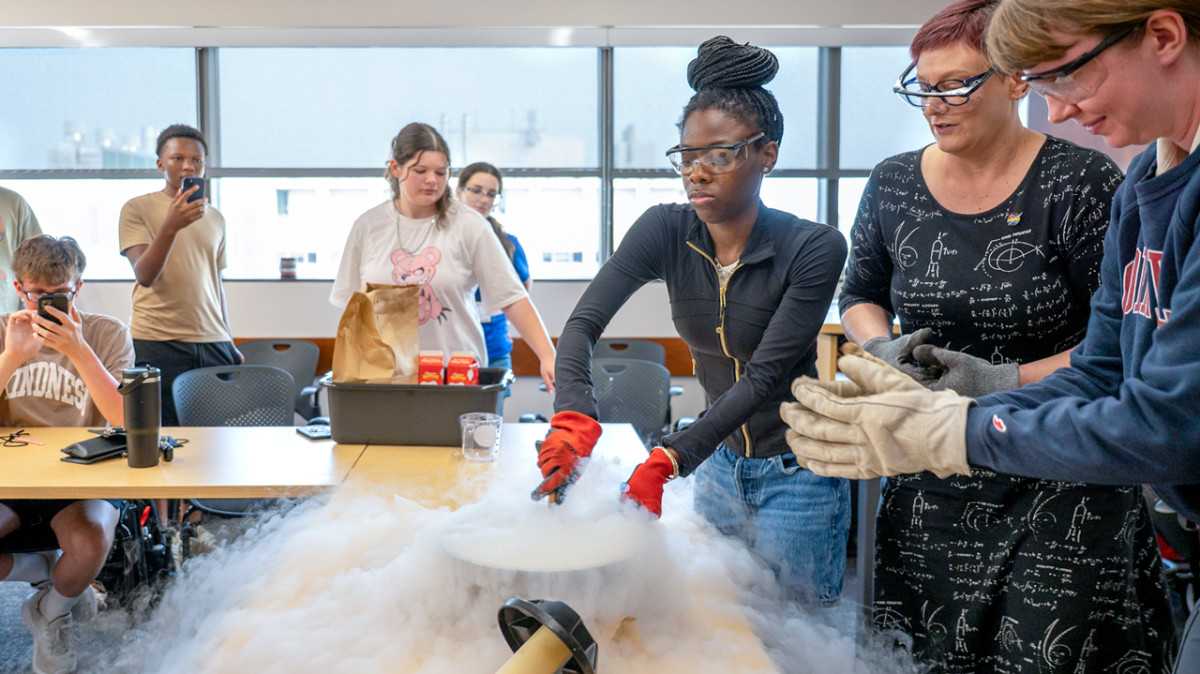
4-H’ers use liquid nitrogen to make ice cream in the session “Exploring the Universe: From Planets to Supernovae.”
More than 20 programs, including six new ones, highlighted this year’s theme, “Planting the Seeds to Possibilities.”
Three programs focused on artificial intelligence in the workplace. In a session hosted by the School of Integrative Plant Science’s Soil and Crop Sciences Section, in the College of Agriculture and Life Sciences (CALS), participants learned about climate science, the science behind AI models and how technology is shaping climate-smart agriculture and forestry.
“I learned that AI has uses beyond homework help or writing essays,” said Gabriella Coelho, an 11th grader from Rockland County. “It’s also used in agriculture to track patterns and improve farming.”
Coelho and her peers got to try out technology like the Cornell Climate Smart Farming program’s online toolkit and the SoilTwin app, which help farmers and other stakeholders make science-backed decisions.
“I think most people think about AI as ChatGPT, as well as large data centers and their environmental impacts,” said Candace Hulbert, program coordinator and education and outreach coordinator for the AI Institute for Land, Economy, Agriculture & Forestry (AI-LEAF) at Cornell. “They’re not necessarily thinking about how AI can provide scientific advancement in the space of agriculture and forestry.”
Hua Wang, a senior lecturer in Cornell Duffield College of Engineering’s communications program, showed participants how to use AI responsibly, considering issues like accuracy, bias and cultural representation. And Allison Hermann, research and outreach manager in the Laboratory for Rational Decision Making in the College of Human Ecology, said people should think of AI as a “sidekick,” or part of a toolkit for decision-making, with the user ultimately making the decisions.
The New York State Water Resources Institute, a new program in CALS, gave students insights on protecting New York’s freshwater resources. Students visited Beebe Lake and a creek to study how water quality, aquatic habitats, invasive species and fisheries coexist.
The 4-H’ers then used what they learned to tackle water resource problems facing Onondaga Lake near Syracuse, presenting their own solutions. Some came away with a deeper appreciation for the science it takes to protect New York’s waters.
“I live right by the St. Lawrence (River),” said David Sullivan, a 12th grader from Jefferson County. “Water is my thing.”
Talking plants
Participants also visited the Boyce Thompson Institute to learn about plant and molecular science. At the Center for Research on Programmable Plant Systems, they saw how researchers are combining sensors, robotic tools and other technologies to enable living plants to communicate.
They also learned about gene-editing and genetically modified organisms, and dissected a purple-colored cherry tomato created by Norfolk Healthy Produce. The variety is bioengineered to contain especially high levels of anthocyanins, which may have antioxidant properties.
In another new program, 4-H’ers learned about becoming a registered dietitian. Inside the Discovery Kitchen at Toni Morrison Dining Hall, Erin Green, director of the Didactic Program in Dietetics, and Sarah Hess, extension associate for Food and Nutrition Education in Communities, shared information about careers paths such as sports dietitian, food service supervisor, food policy expert, food scientist and consultant.

Food, Fitness & Futures in the Discovery Kitchen exposed students to the exciting career of a Registered Dietitian, getting hands-on practice with food safety skills and recipe prep.
Green, Hess, Maisie McManus ’27 and Ann Jie Teo ’27 walked 4-H’ers through making healthy granola bars using flax seed, bananas, applesauce, oats, honey, chocolate chips and sunflower butter. The team made a substitution on the fly to accommodate one student’s allergy.
“That’s part of being an R.D.,” Green said, “having to make recipe adjustments and knowing what substitutes are appropriate.”
The conference’s closing ceremony featured keynote speaker Richard Ball, commissioner of the New York State Department of Agriculture and Markets. Ball began his farming career at age 18, and has owned and operated Schoharie Valley Farms since 1993. He told the 4-H’ers that technological advancements in agriculture have created new career opportunities for the next generation of agricultural workers.

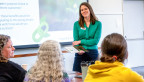
Participants in the Youth Investigators program work together to structure interview questions.
“When I think about the food system, when I think about logistics, food safety, blockchain technology, transportation, culinary arts, research and genetics, and AI – we’re talking about nearly half of the jobs in our world today,” Ball said. “You are the next generation of people that are going to research and figure out how to do these things better.”
Juan Vazquez-Leddon is the communications director for the Bronfenbrenner Center for Translational Research. Paul Treadwell is a distance learning specialist and writer for Cornell Cooperative Extension. Marc Ducharme is the communications coordinator for Cornell Cooperative Extension.
Media Contact
Get Cornell news delivered right to your inbox.
Subscribe