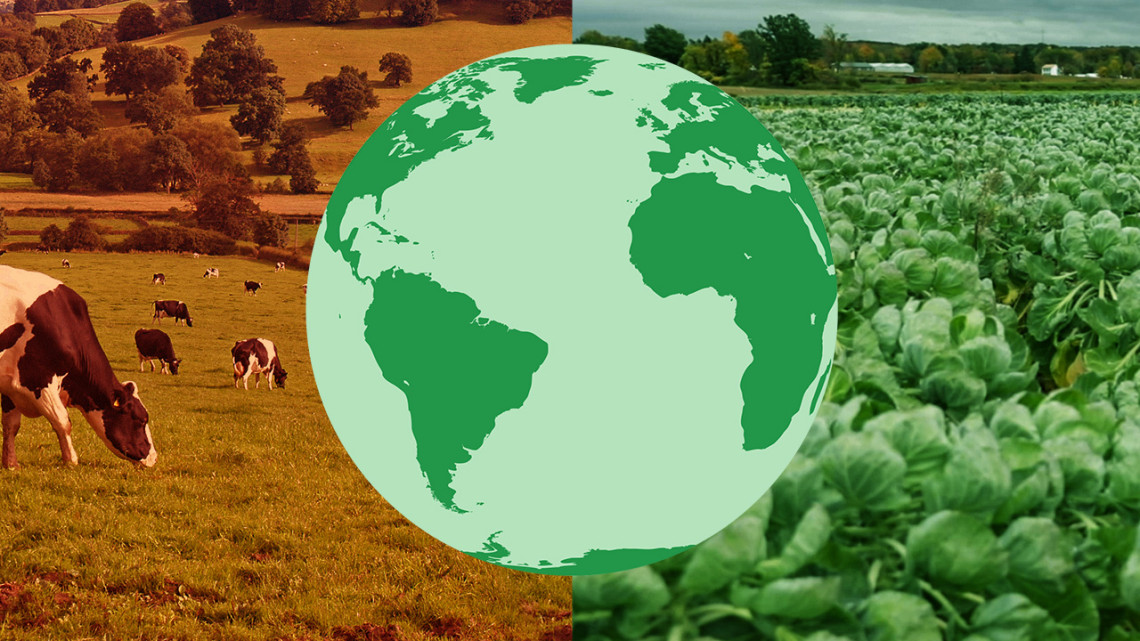
The diet that could remake modern agriculture
By Laura Reiley, Cornell Chronicle
A full-scale shift toward healthier diets, combined with improved farm productivity and a halving of food waste, could reduce global agricultural land use roughly 6% by 2050 – an area the size of India – and lead to a 42% decline ($630 billion) in global livestock production value, according to a sweeping new analysis published in the May edition of Nature.
That reversal would be historically unprecedented, marking one of the first sustained contractions in farmland in modern history. The reason is straightforward but profound: a world that eats differently farms differently.
“This work underlines that the scale of this change is huge and the policy ambition has to be commensurate with the challenge,” said Matthew Gibson, former postdoctoral associate in the Food Systems and Global Change research group in the Cornell CALS Ashley School of Global Development and the Environment. “We have to think about a coordinated push involving governments, industry and consumers alike.”
Gibson, currently a research fellow at the London School of Hygiene and Tropical Medicine, led the study, which attempts to map what would happen if the world actually followed through on years of calls for healthy diets from more sustainable food systems. The researchers found that transforming the global food system following EAT-Lancet recommendations would not simply tweak agriculture at the margins. It would fundamentally remake it – shrinking the footprint of farming, slashing livestock production and redirecting what the world grows and eats.

The study considers wider implications of the 2025 EAT-Lancet Commission, which was coordinated by Cornell and yielded the second EAT-Lancet report last year and a special issue in Lancet Planetary Health.
Gibson and four Cornell co-authors contributed to the modelling in the Lancet report and this paper: Mario Herrero Acosta, professor; Daniel Mason-D’Croz, senior research associate; and Marina Sundiang and Thais Diniz Oliveira, current and former postdoctoral researchers, all in the Ashley School.
“But it’s not a linear path from A to B. It won't be nice and tidy,” Gibson said. “We were trying to tease out the facets that make it messy and put numbers on how sectors might shrink or grow.”
In the study’s modeled “transformation” scenario – based on dietary patterns similar to those recommended by the EAT-Lancet Commission – people eat far less red meat (e.g., beef, pork, and lamb), and more fruits, vegetables, legumes and nuts. That shift ripples backward through the system. With fewer animals to feed, demand for crops like corn and soy declines. Vast stretches of grazing land become unnecessary. And the agricultural economy, long centered on livestock, begins to pivot.
“Often these kinds of changes are presented as relatively small or easy because in principle anyone can adopt a healthy diet, which overstates the impact of individual choice,” Mason-D’Croz said. “A radical shift in food production and consumption requires more than marginal fixes. Systematic changes require real political capital and will.”
Production of ruminant meat could fall by a third in 2050 compared to 2020, and the economic value of this production could decline by 70%. This would be accompanied by around 400 million fewer ruminant animals for slaughter each year. Cereals and sugar crops would also shrink in such a future.
In their place, fruits, vegetables, nuts and legumes would expand, both in acreage and importance. By mid-century, these foods could account for the majority of agricultural production value, a sharp departure from today’s system where livestock still dominates.
Food systems today are responsible for roughly one-third of global greenhouse gas emissions, as well as major water use and fertilizer runoff. Under the transformation scenario, agricultural emissions fall sharply – by about a third compared to current trajectories – driven largely by the decline in livestock, particularly methane-intensive cattle.
Water use and fertilizer application are also lower compared to business-as-usual projections, easing pressure on ecosystems already stretched to their limits. Land freed from agriculture could, in theory, return to forests or other natural systems, offering additional climate and biodiversity benefits.
And yet, the picture is not one of simple gain, according to Herrero: “There will be pain points and potential losses. We have to find ways to compensate and incentivize farmers and ranchers to make these huge changes. If we want multifunctional food systems, we need multifunctional payments beyond those linked to agricultural production”
Economically, the global value of agricultural production by 2050 would shrink by about one-quarter compared to a business-as-usual future, which equates to roughly the figure for 2020. For some regions and sectors, that contraction could be destabilizing, for others it could present opportunities. For example, the United States could see livestock production value decrease by 73% but crop production value increases by 20%. Other large livestock producers, such as Brazil and China, could see steep declines in output and income. Rural communities built around cattle, dairy or feed crops could face painful transitions.
Even within agriculture, the shifts are uneven, Gibson said. Jobs tied to livestock production would fall more sharply than those in crop farming, potentially reshaping rural labor markets. Trade patterns would shift as well, with some regions exporting less meat and importing more plant-based foods.
That imbalance helps explain why change has been slow. Governments continue to subsidize many of the very systems that drive poor health and environmental harm, the researchers said. Efforts like sugar taxes, food labeling and dietary guidelines, while important, operate at the margins of a much larger system shaped by entrenched interests, according to the paper.
Consumer behavior adds another layer of complexity. The study assumes a relatively smooth shift toward healthier diets, but in reality, food choices are bound up with culture, affordability and habit. For many people, especially in lower-income countries, healthier diets remain out of reach. For others, giving up meat is less a question of cost than of identity.
Even so, the researchers argue that the scale of potential benefit makes the effort unavoidable.
“If we want to transform the food system for the better," Gibson said," to improve health, reduce waste and have more sustainable production, you have to make it happen. Without bold and inclusive intervention, the food system may well transform, but in a way the does not serve people or the planet.”
This would require reshaping subsidies, investing in new technologies and managing the social fallout for those whose livelihoods are at stake, the paper suggests.
The modeling coordination for this work was funded by Bill and Melinda Gates Foundation through a grant to Cornell, and the Cornell Atkinson Center for Sustainability.
Media Contact
Adam Allington
Get Cornell news delivered right to your inbox.
Subscribe