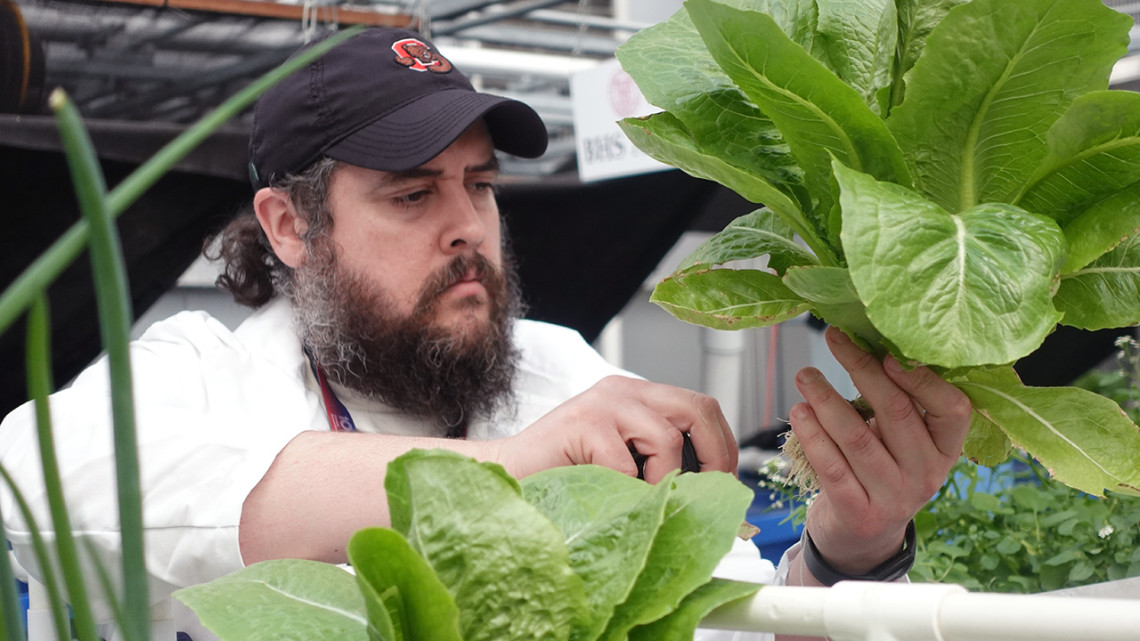
Barry Rothstein, extension support specialist for Cornell University Cooperative Extension-NYC, tends to the plants growing in the Cornell Hydroponics Learning Labs at Park West Educational Campus in Manhattan.
Learning labs cultivate knowledge – and produce – for students
By Sheri Hall
When Denise Perez realized she could use what she was learning about food insecurity and hydroponics to help her classmates at the High School of Hospitality Management in Manhattan, she decided to do something about it. With help from the Cornell Hydroponics Learning Labs, she designed an independent project to grow produce specifically for her fellow students, 91% of whom are economically disadvantaged.
“I know how to build a hydroponic system, I know about food insecurity and I personally believe that food is a human right,” she said. “I grew up in a household where I was taught always to share food. I work in a lab. We’re growing food. We’re donating to a community fridge – why can’t we give food to students at the school?”
The Hell’s Kitchen neighborhood in which the school is located is known as a “food swamp.” Similar to a food desert, where a significant percent of the population lives more than a half mile from the nearest supermarket, a food swamp is where fast food and junk food crowd out healthier options. And in Manhattan, at least 16.5% of residents are at risk of food insecurity, according to a 2025 Food by the Numbers report from the New York City Mayor’s Office of Food Policy. That percentage is higher for non-white residents. With SNAP benefits becoming harder to access, and other safety nets becoming less certain, Perez saw a need for a produce pipeline.
Perez interns with the hydroponics labs, which operate out of the Park West Educational Campus that houses the High School of Hospitality Management, the Food and Finance High School, Manhattan Bridges High School and three other schools. The labs are managed by Cornell University Cooperative Extension – New York City (CUCE-NYC).
The heart of the program is a hydroponics room on the third floor, where plants are grown without soil or natural light, and a rooftop greenhouse. Each year, up to two dozen students spend six hours a week in the labs learning crop-planting, transplanting, harvesting and water quality maintenance. They are paid as interns through their schools.
The labs produce lettuce, cilantro, bok choy and watercress – and cultivate knowledge among high school students growing the food. Barry Rothstein, Maya Kutz and Imani Dailey lead the program and teach lessons across a range of disciplines: STEM, nutrition, sustainability, business skills and more.

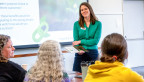
Maya Kutz, extension support specialist for Cornell University Cooperative Extension-NYC, holds a tray of plants growing in the Cornell Hydroponics Learning Labs.
“We’re trying to break the disconnect of where your food comes from,” Rothstein said. “We are not only teaching science-based skills but also helping students understand the food system and develop interpersonal skills as they work together.”
The students supply the culinary program at Food and Finance High School – the only career and technical-education culinary school in New York City – with the produce they’ve grown. They also donate to a local community-based food pantry.
Perez began her project by developing a survey to determine what types of produce students would use. She distributed the survey in English as well as Spanish to reach the school’s large Spanish-speaking population.
“Everyone comes from different backgrounds, and I’m trying to grow produce that connects with their culture,” she said.
In January, Perez began seeding crops based on the survey results. Throughout the school year, she organized eight distributions, taking a cart of fresh produce through the school and offering it directly to students.
Cilantro was this year’s most in-demand item — so much so that some weeks Perez spent two hours seeding it just to keep up. The project also taught her marketing and project management skills, according to Kutz.
“It was a good learning experience in understanding how to reach the audience that you want,” Kutz said. “How do you get buy-in and participation?”
Perez graduated this spring. She has been accepted to Lehman College and hopes to study abroad in Taiwan.
“Denise gained knowledge, saw a need in her community and acted on it. This is what it means to bring Cornell’s expertise into New York City’s neighborhoods,” said Jenny Weil Malatras, CUCE-NYC executive director. “It’s not just sharing information, but meeting young people where they are, giving them access to real science and real skills, and expanding what they believe is possible.”
Media Contact
Get Cornell news delivered right to your inbox.
Subscribe