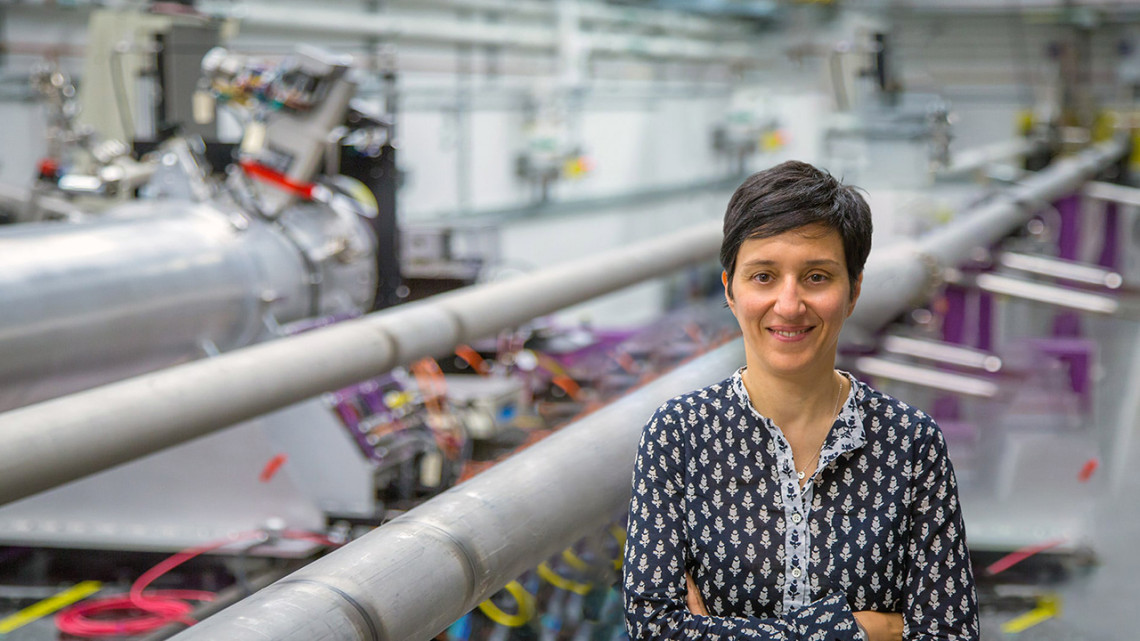
Gabriella Carini will be the new director of the Cornell High Energy Synchrotron Source starting Oct. 1.
Gabriella Carini named CHESS director as facility readies for the future
By Rick Ryan
Gabriella Carini, associate laboratory director for discovery technologies at Brookhaven National Laboratory, has been appointed director of the Cornell High Energy Synchrotron Source (CHESS) and professor in the Sibley School of Mechanical and Aerospace Engineering in the Cornell Duffield College of Engineering. She will begin Oct. 1.
Carini, who has held leadership positions at the Brookhaven laboratory and at SLAC National Accelerator Laboratory for more than two decades, currently oversees Brookhaven’s scientific programs in instrumentation, accelerator science, quantum technologies, microelectronics and advanced research infrastructure.
The appointment comes at a pivotal moment for CHESS, the only high-energy synchrotron located at and operated by a university in the United States. As scientific challenges grow increasingly complex and interdisciplinary, CHESS is expanding its capabilities through major investments in advanced instrumentation, high magnetic field science, artificial intelligence-driven experimentation and new beamlines designed to serve emerging scientific communities.
“Gabriella brings a remarkable combination of scientific vision, technical expertise and leadership experience to this role,” Provost Kavita Bala said. “As an internationally recognized leader in her field, she understands both the cutting-edge technologies that advance modern discovery and the collaborative culture required to operate a world-class user facility. We are delighted to welcome Gabriella to Cornell.”
Carini succeeds Joel Brock, who will step down on Oct. 1 after serving as CHESS director since 2013. During his tenure, Brock oversaw significant modernization efforts, strengthened the facility’s national user program, guided the completion of the CHESS-U upgrade and navigated a new partner-funding model.
“Joel’s leadership transformed CHESS and laid the foundation for the opportunities we see today,” said Gary Koretzky, vice provost for research. “He guided the facility through a period of tremendous change while maintaining a steadfast commitment to scientific excellence and user support. We are deeply grateful for his service and leadership.”
Each year, roughly 1,500 researchers from around the world travel to CHESS to study quantum materials, energy technologies, advanced manufacturing processes, biological systems, environmental challenges and agricultural questions using powerful synchrotron X-rays. The facility supports hundreds of scientific projects annually and serves researchers from universities, national laboratories, government agencies and industry.
“CHESS occupies a unique place in the scientific ecosystem,” Carini said. “Its combination of world-class accelerator expertise, innovative beamline capabilities and close connection to Cornell’s research community creates extraordinary opportunities for discovery. I am excited to work with the CHESS team, Cornell researchers and our users from around the world to expand the facility’s scientific impact and develop new capabilities for future generations of scientists.”
In addition to her faculty appointment in Duffield Engineering, Carini will hold an appointment in the Department of Physics in the College of Arts and Sciences, expanding her collaborations across the university.
As director, Carini will oversee CHESS’s expansion, including XLEAP (X-rays for Life, Environment, Agriculture, and Plants), a major new beamline initiative that will expand CHESS’s capabilities in the life and environmental sciences. Expected to begin serving users in 2028, XLEAP will enable researchers to investigate plants, soils, microbes and other complex biological and environmental systems.
At the same time, CHESS is commissioning its High Magnetic Field Beamline (HMF), which combines powerful X-rays with some of the world’s strongest magnetic fields to explore quantum materials and other complex systems. The capability will allow researchers to observe how the atomic and electronic structures of materials change under extreme magnetic fields, opening new opportunities to study superconductivity, magnetism and other quantum phenomena.
Both XLEAP and HMF are supported by the National Science Foundation.
CHESS researchers are also developing new approaches that integrate artificial intelligence, machine learning, automation and advanced computing into synchrotron experiments. These tools can help guide measurements in real time and enable multimodal analysis, building a more complete understanding of complex materials while making effective use of valuable beamtime.
Carini said the opportunity to lead CHESS during this period of transformation was a major factor in her decision to join Cornell.
“The future of scientific discovery will increasingly depend on the integration of advanced instrumentation, computation, automation and collaboration across disciplines,” she said. “CHESS is exceptionally well-positioned to help shape that future.”
Rick Ryan is an associate director of communications for Cornell Research and Innovation.
Media Contact
Get Cornell news delivered right to your inbox.
Subscribe