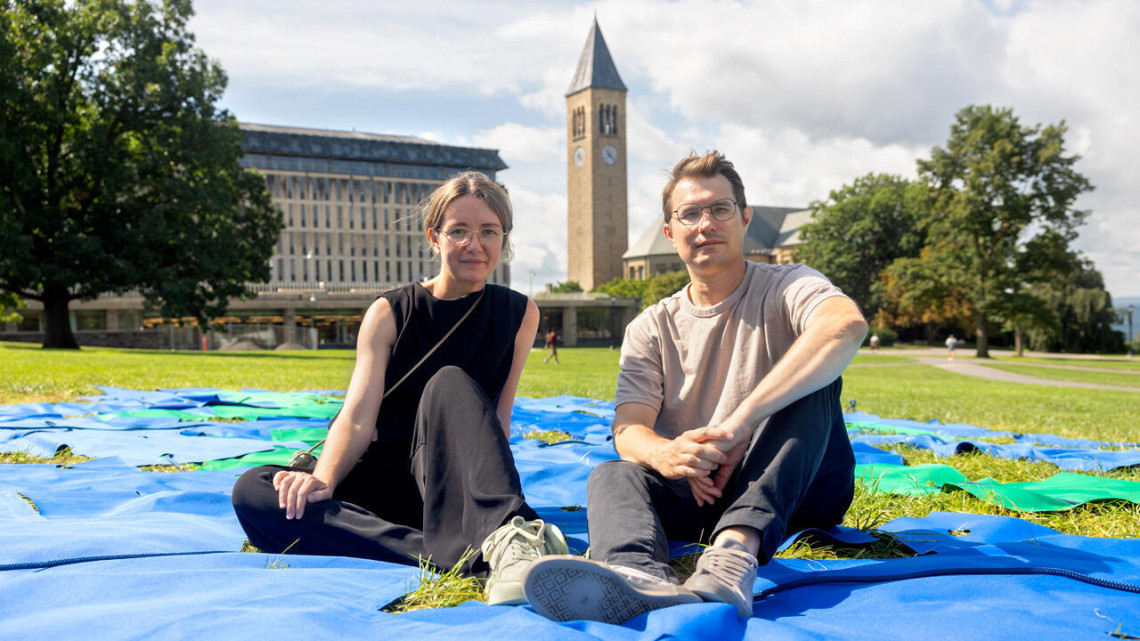
Suzanne Lettieri and Michael Jefferson, faculty members in the Department of Architecture in the College of Architecture, Art and Planning, experiment with chroma-keyed color and AI in “Vibe Coating,” an installation now on the Arts Quad.
Good vibes: Phones promote shared space, not silos, in Arts Quad installation
By James Dean, Cornell Chronicle
What’s your vibe?
Answer that prompt and a design research project installed on the Arts Quad invites visitors into an immersive space that they help design in the moment, blending physical and digital experience.
“Vibe Coating,” created by College of Architecture, Art and Planning (AAP) faculty members Suzanne Lettieri, M.Arch. ’12, and Michael Jefferson, M.Arch. ’12, features roughly 30 blue and green pieces of fabric arrayed on the grass like a giant picnic blanket. The garment-style pieces – designed by Cedric Lalanne, M.Arch. ’22; and Lewis Campbell ’24 of USEISM – to function as blankets or be worn like capes – feature “chroma-keyed” pigments, incorporating the same green-screen technology used for TV weather reports and movie special effects.
Through a web-based app, programmed by Ryan Whitby, visiting critic in the Department of Architecture (AAP), provided at the site through a QR code, participants input their vibe using descriptive language (e.g. “rainy day,” “golden hour,” “neon glow”). After selecting blue or green channels, or both, a smart phone’s camera overlays the fabric with an AI-generated image reflecting a group’s collective mood. The downloadable image evolves with each new prompt.

“Vibe Coating” gathers participants’ contributed “vibes” to form an atmospheric, continuously evolving collective image that is projected onto chroma-keyed blue and green pieces of fabric, which can be used as blankets or worn like capes.
Demonstrating the process on a recent morning near A.D. White’s statue (the project will relocate periodically to protect the grass) the designers appeared through the app to be seated on a shimmering purple blanket with touches of fiery orange (colors also picked up by parts of the then-blue sky). Responding to the 10 most recent vibes, the app described the AI-generated atmosphere as depicting “swirling matcha latte texture cutting through dark compressed shadows; vibrant rainbow gradient lighting.” A few days later, the vibe included “a chaotic explosion of geometric golden-yellow.”
“Whoever’s here changes the media itself, and their accumulated vibes will show up as a kind of shared, visual atmosphere on this fabric,” said Jefferson, a lecturer in AAP. “The bigger aim, more conceptually, is that instead of phones creating silos that separate us, we can try to use that siloing against itself to bring people together in this space.”
For Jefferson and Lettieri, assistant professor of architecture (AAP), “Vibe Coating” is an extension of an installation featured last year at Exhibit Columbus in Indiana, a stage for emerging designers. Both projects investigate ways to harness design and technology to create socially constructive public spaces, leveraging the interaction between chroma-key, a relatively old technology embedded in bright, primary colors, and more modern tools.
Lettieri plans to give a talk about the work titled “Social Surfaces” at an upcoming Pratt Institute symposium and recently published an article about “Apart, Together,” the Indiana installation, in the journal CriticalProductive. At Cornell and in workshops with high school students in Columbus, New York City and elsewhere, the designers also are exploring how to incorporate those principles in educational curricula and programming.
“Particular hues and saturations of green and blue are instantly recognizable as placeholders for alternative backgrounds to come,” Lettieri wrote of chroma-key technology in the journal article. “They are interlocutors that allow users to replace physical color with digital imagery while superimposing dual existences: one operating in real life, the other revealed through a technological lens.”
After experimenting with fabric cloaks at Exhibit Columbus, Lettieri and Jefferson updated the idea to engage participants more in generating the visual effects. The project’s name plays on “vibe coding” – using natural-language prompts to write code with AI – and the fabric’s wearability. While the national vibe has grown increasingly critical of AI’s potentially harmful impacts, Lettieri and Jefferson are exploring its potential to strengthen community.
“We want to think more broadly about how we can meet people across disciplines in spaces where everyone converges, and use technology as a means to do that, rather than something that seems to separate us more and more,” Jefferson said. “The most enjoyable thing is to see students and others using this architecture and experiencing it – because that means it’s working.”
Supported by the Cornell Council for the Arts “Vibe Coating” opened Aug. 30 and will be on display through Sept. 20. The team also includes undergraduates Kalven Owen, B.Arch. ’28; Annie Wang, B.Arch. ’29; and Joe Yuan, B.Arch. ’28.
Media Contact
Get Cornell news delivered right to your inbox.
Subscribe