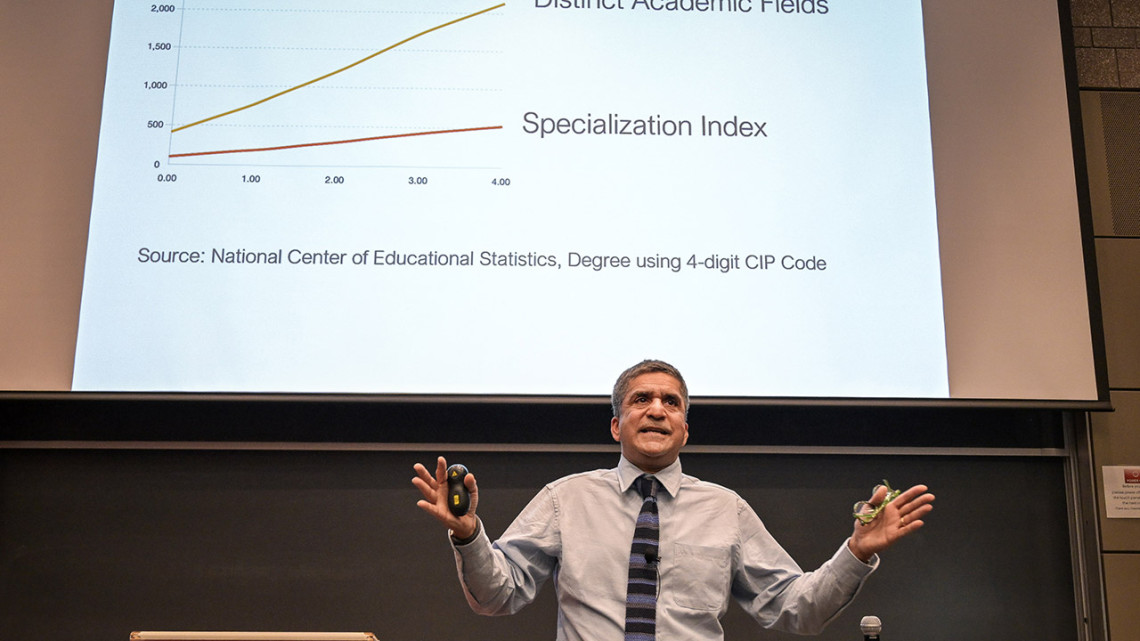
Rakesh Khurana ’90, the Marvin Bower Professor of Leadership Development and Unit Head of Organizational Behavior at Harvard Business School, delivers the Milton R. Konvitz Memorial Lecture.
Holding a mirror to itself, higher education can restore trust in ‘sacred’ mission
By James Dean, Cornell Chronicle
At prestigious U.S. universities in recent decades, academic fields grew more specialized, centers and institutes proliferated, administrative support swelled and tuition rose faster than inflation – all while admission rates dropped.
The result: a loss of public trust as higher education’s focus shifted from its “sacred” mission – educating society’s young people – to managing bureaucracy, according to Rakesh Khurana ’90, the Marvin Bower Professor of Leadership Development and Unit Head of Organizational Behavior at Harvard Business School.
“The way we grew led to a growth in our bureaucracy, and the result was that we became unadaptive,” said Khurana, delivering the ILR School’s annual Milton R. Konvitz Memorial Lecture on Sept. 17 in Ives Hall. “But I am optimistic, because I think there are so many people focused on this that we are actually getting a handle on what this means.”
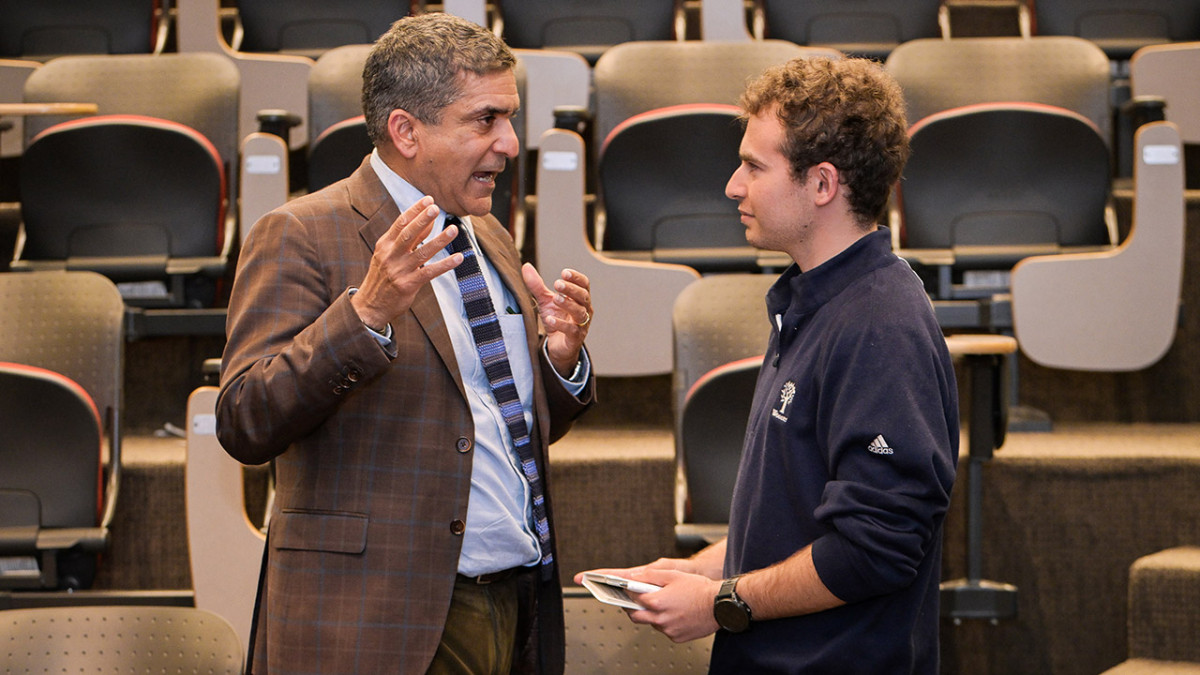
Khurana speaks with a lecture attendee.
Alexander Colvin, Ph.D. ’99, the Kenneth F. Kahn ’69 Dean and the Martin F. Scheinman ’75, M.S. ’76, Professor of Conflict Resolution at ILR, welcomed Khurana, an ILR graduate who is also a sociology professor at Harvard University and served as the dean of Harvard College from 2014-25. His talk, “From Institutional Mission to Administrative Means: The Bureaucratization of Universities,” was co-sponsored by Cornell’s Committee on the Future of the American University.
“With this combination of his academic interests and his leadership experience at Harvard College,” Colvin said, “Professor Khurana brings a particularly valuable perspective on where the future of the American university is headed.”
Calling himself a “loving critic” of higher education, Khurana said it wasn’t long ago that American universities were being touted as the world’s greatest – drivers of innovation, producers of Nobel Laureates and keys to a knowledge-based economy. Now, amid threats to federal research funding and a bipartisan erosion of confidence, they are riddled with uncertainty.
“How did we get here?” Khurana asked. “How could something have gone from being so great just a few years ago to having lost [the public’s] confidence?”
Some of the strain is due to more recent political pressure, Khurana said, but questions about costs, elitism, political bias and the handling of public controversies began much earlier and universities could have addressed them sooner.
“Society is holding a mirror to us,” he said. “We should have held it up to ourselves first.”
With their origins as part of religious education and claims to seeking truth for its own sake, American universities evolved as moral institutions, Khurana said. But since education’s outcomes – such as shaping a better citizen or developing cures for diseases – aren’t always straightforward, universities have relied on a general belief that they fulfill such functions.
“We really depend on legitimacy, that people have to sort of be okay with our complexity and our opaqueness,” he said. “But these same qualities of ambiguity and vagueness increase the probability of misunderstanding, disappointment and conflict when legitimacy erodes.”
Challenges have emerged in part due to universities’ success, he said, and from often well-intentioned initiatives. Enrollment grew enormously in the post-World War II era, bolstered by state support and a surge in federal funding for research seen as increasingly vital. But universities became increasingly reliant on federal funding and other external sources, including very wealthy private donors.
Along with growth in scale, Khurana said, came increasing differentiation, as new academic fields and specializations emerged, such as bioinformatics, data science and environmental engineering. Since 1980, he said, the number of federal codes describing academic fields grew more than 500%, and higher education tended to grow without subtraction.
“Any time we did something new, we could add,” Khurana said, “but we very rarely consolidated or closed something else.”
At the same time, university student services once provided informally became professionalized to improve consistency and reliability, from student advising and faculty mentoring to support for first-generation and low-income students. Among the top research universities and top liberal arts and science colleges, Khurana said, growth over the last 50 years has been concentrated in offices for advising, counseling and mental health, career services, disability, multicultural affairs, ROTC and veterans, and international students. Each created a constituency to be sustained.
Over time, universities articulated sometimes vague or conflicting mission statements, Khurana said. And these trends influenced who was tapped to lead institutions: managers, rather than leaders driven by values and mission.
“As you create this complexity and greater bureaucracy,” he said, “you increasingly are putting people in senior roles who can manage that complexity and that bureaucracy.”
Citing President John F. Kennedy’s remark at a 1963 convocation that “a university has a special obligation to hold best to the past and move fast to the best of the future,” Khurana said he’s optimistic that higher education can restore a commitment to, and trust in, its mission. The challenge will be met collectively, without finger-pointing, including through efforts such as those of the Committee of the Future of the American University, he said.
“This is a sacred duty that we have, and I think part of how we get to it is reminding ourselves that we’re not just a functional technical institution, that we actually have a sacred mission that’s imbued with meaning and purpose,” Khurana said. “That poetry, that value, is what makes an institution an institution, as opposed to just an organization.”
The Konvitz Lecture is endowed by Irwin M. Jacobs ’54, BEE ’56, and the late Joan K. Jacobs ’54.
Media Contact
Get Cornell news delivered right to your inbox.
Subscribe