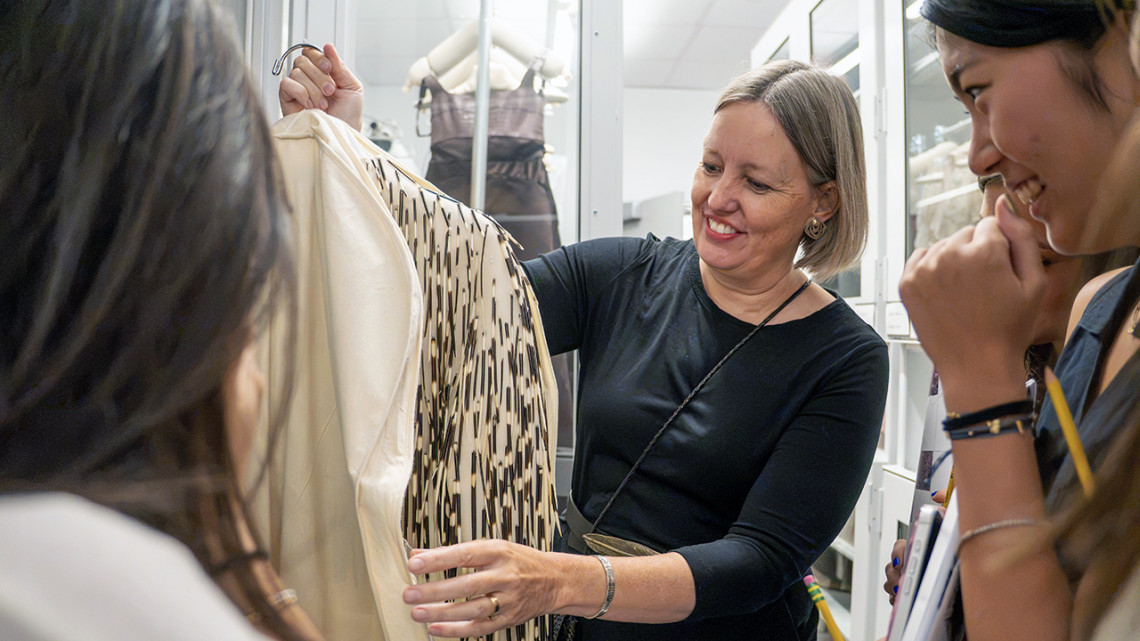
Catherine Blumenkamp, associate director of the Cornell Fashion + Textile Collection, shows a white satin bolero with porcupine quills to students at the beginning of the semester. Alternating white and brown quills are attached by metal loops and white thread. This piece was shown as part of the Spring 2007 Haute Couture collection.
Now at Cornell, legendary designer’s collection inspires the next generation
By Robin Roger
Denise Green and her students gasped as they uncovered the relics from inside the long unopened garment bag, a time capsule from another era.

Ralph Rucci in his New York City apartment.
Porcupine quills tinkled when Maya Abrol ’26 and Tabitha Mueller-Schrader ’26 lifted out an intricate bolero. The fashion design students were preserving and cataloging a piece from one of Ralph Rucci’s acclaimed haute couture collections, which was donated to the Cornell Fashion + Textile Collection (CF+TC).
“It was one of those rare moments when you immediately understand that you are in the presence of something extraordinary,” said Green, the Lau Family Associate Professor in Fiber Science and Apparel Design and director of the CF+TC. “I remember feeling a combination of awe, responsibility and urgency, because I immediately wanted students to be able to see what I was seeing – to understand that fashion can be this complex, this demanding and this moving.”
For the first time in over a decade, garments from Rucci’s haute couture and ready-to-wear collections have been brought together under one roof as part of the CF+TC in the College of Human Ecology. Documentary materials, including thousands of original sketches, patterns and swatches, are housed by the Kheel Center for Labor-Management Documentation and Archives at Cornell University Library. The archive is now accessible to students, researchers and the public, ensuring Rucci’s legacy lives on and inspires future generations of designers.
“Getting to experience Ralph Rucci’s work up close reminded me of the endless possibilities to innovate in the field of fashion,” said Mueller-Schrader, now an assistant designer at Tuckernuck. “With each piece I looked at, I was inspired to rethink what can be achieved when innovation and artistry are put at the forefront of design.”
Rucci’s uncompromising approach to design, exacting craftsmanship and commitment to couture earned him a devoted clientele, including Oprah Winfrey, Elizabeth Taylor, Martha Stewart and Patti Smith. He was the first American fashion designer with a design house established in the United States to be invited by the celebrated Chambre Syndicale de la Haute Couture to show in Paris, and, in November 2025, the Council of Fashion Designers of America awarded Rucci the Geoffrey Beene Lifetime Achievement Award.
Yet most Americans have never heard of Rucci. That’s because he never pursued visibility through mass-market production, choosing instead to preserve the integrity of his vision through couture and made-to-order work.
“Ralph Rucci’s work stands out because it represents one of the rarest forms of fashion practice in the United States: a true atelier model built around uncompromising quality, spectacular handwork and deep respect for the skilled artisans and craftspeople who make the clothes possible,” Green said. “His collections do not rely on chasing fads or novelty for its own sake. There is an enduring timelessness to his work that comes from the strength of the design itself. The closer you look, the more the garments reveal themselves, and the more astonishing they become. Every seam, surface treatment, material choice and structural decision reflects an extraordinary level of labor and technical refinement.”
The archival collection, encompassing works from 1978 through 2015, includes sketches, patterns, photographs, lookbooks and nearly 500 items of clothing. Feathers, gemstones, alligator, porcupine quills, wooden beads, horsehair, PVC vinyl and glass beads are transformed to behave in structurally unexpected ways. Rucci also embellished garments with elaborate surface work, including pintucks, appliqué, embroidery, perforation, beading and hand-painting.
“Rucci’s work resists mass production because so much of its meaning and structure is in the hand, the fit and the construction,” Green said. “These are not garments that can simply be flattened and reproduced at mass scale without losing something. The labor is essential to the design. Time is part of the design. The way a seam is finished, the way an inset is lined and suspended, the way a pocket is hidden, and how material responds to the body’s form and movement – those are not incidental details, but integral to the spirit of the garment.”
Perfect for a teaching context
In order to understand the pieces, Green said, you need to look closely, especially inside them, which is why they work so well in a teaching context. Students can learn about design, construction, material manipulations, fit and movement from the garments. The paper materials add a critical dimension: What made these garments possible?
The documentary portion of the collection includes 125 cubic feet of paper materials: approximately 8,000 sketches, 3,000 patterns, thousands of fabric swatches and hundreds of photographs. The patterns, dating back to 1999, were custom-made to the specifications of about 400 clients.
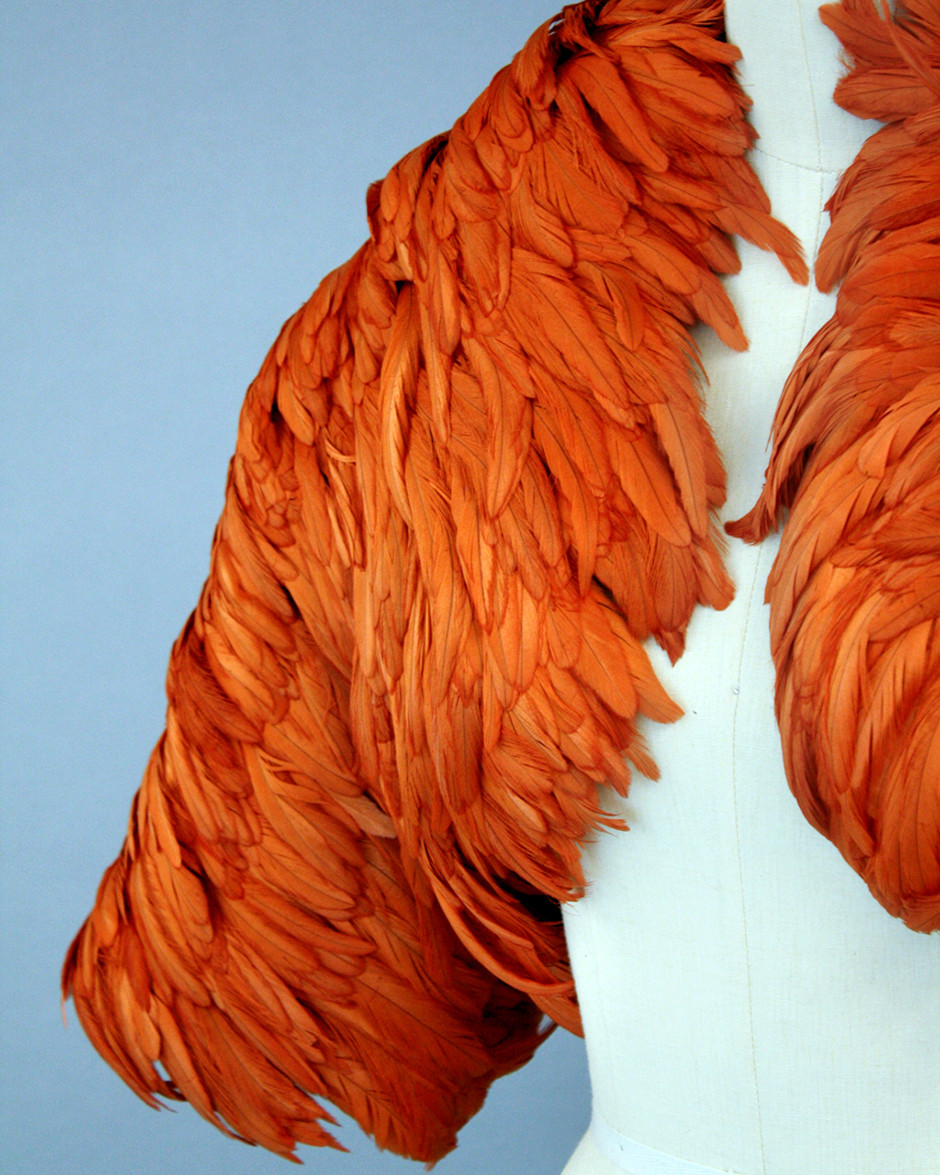
This orange feather bolero, with a short-waisted silhouette and three-quarter length sleeves, was shown as part of the 2007 Fall/Winter Ready-to-Wear collection. The surface is covered with overlapping rooster feathers arranged in diagonal bands radiating from the center back and neckline.
The Kheel Center is stewarding the collection’s documentary materials, which offer insight into the unseen labor behind high-end fashion production in the United States.
“One can see the evolution of ideas from Rucci’s sketches with handwritten notes appended with feathers, fabrics and color schemes in the Kheel Center to the final garments in Cornell’s Fashion and Textile Collection,” said Steven Calco, head of the Kheel Center. “Studying the design from inception to execution will be invaluable for students learning these fashion design skills at Cornell and the profession at large. Preserving these records ensures students and future researchers can study the relationship between design, craft, labor and production in the fashion and textile industries.”
After graduating from the Fashion Institute of Technology (FIT), Rucci briefly worked for the American designer Halston before holding his first made-to-order runway show in 1981. He and his FIT classmate launched a ready-to-wear label in 1984, but it ceased operations after the Black Monday stock market crash in 1987. In 1994, he launched Chado Ralph Rucci, named after the Japanese tradition of tea ceremony. He left his eponymous label in 2014, launched RR331 – named for the number of steps in the Chado tea ceremony – two years later, and returned to the Paris haute couture calendar in 2019.
Green said the collection will enable collaborations across Cornell, since his work connects to a wide range of materials and collections: the Herbert F. Johnson Museum of Art, the Cornell Plaster Cast Collection, the Anthropology Collections and the thousands of bird specimens in the Cornell University Museum of Vertebrates.
Robin Roger is assistant dean for communications at the College of Human Ecology.
Media Contact
Get Cornell news delivered right to your inbox.
Subscribe