News directly from Cornell's colleges and centers
Air Force award supports research into resilient spacecraft coordination
By Chris Dawson
When a team of autonomous spacecraft is working together on a mission, communication is essential. Each spacecraft needs to know what its partners are doing, where they are and how their actions fit into the larger operation.
But what happens when an adversary disrupts those communications, leaving the spacecraft unable to coordinate their movements or even determine where their partners are located?
Gregory Falco, assistant professor in Cornell’s Sibley School of Mechanical and Aerospace Engineering, has received a Young Investigator Program award from the Air Force Office of Scientific Research to investigate an unconventional solution: teaching autonomous spacecraft to maintain their teamwork by observing the behavior of the adversary trying to disrupt them.
The three-year award, expected to provide approximately $450,000 in funding, will support the development of an artificial intelligence system that allows teams of robots to infer what is happening around them and continue their collaborative mission even when conventional communication becomes impossible.
The project, called TELLS (Targeted Employment of uncooperative Liaisons to Learn State), draws inspiration from an unlikely source: poker.
In poker, experienced players look for subtle clues, or “tells,” in their opponents' behavior to make educated guesses about the cards they are holding. Falco believes autonomous robots can learn to do something similar.
“By observing an adversary – looking for their ‘tells’ – a robot could deduce what another friendly robot is doing,” Falco said, “even if the two cannot communicate directly.”
For example, if an adversarial spacecraft suddenly changes direction, a robot might recognize that the maneuver is a response to another friendly spacecraft approaching from outside its field of view. By interpreting the adversary’s behavior, the robot could develop a better understanding of its surroundings and adjust its actions accordingly.
The approach addresses a fundamental limitation of many existing artificial intelligence systems used to coordinate swarms, especially large swarms, of autonomous machines. Such systems often depend on information shared among team members. When that information becomes unavailable, unreliable or too voluminous given the scale of the group, their ability to cooperate can deteriorate. Focusing attention on a single adversary reduces complexity, while providing clarity on the operating environment.
Falco’s research aims to give each robot the ability to independently reconstruct enough of the larger situation to continue contributing to the team’s mission.
The work builds on several years of research in Falco’s Aerospace ADVERSARY Lab, which has developed technologies enabling spacecraft to evade threats, defend themselves against cyberattacks, locate adversaries and predict potentially hostile movements.
To develop TELLS, Falco’s team will use machine learning to train robots to interpret limited observations of an adversary. Researchers will then introduce increasingly sophisticated, simulated opponents capable of deceptive behavior, testing whether the robots can recognize misleading signals and adapt to unfamiliar strategies.
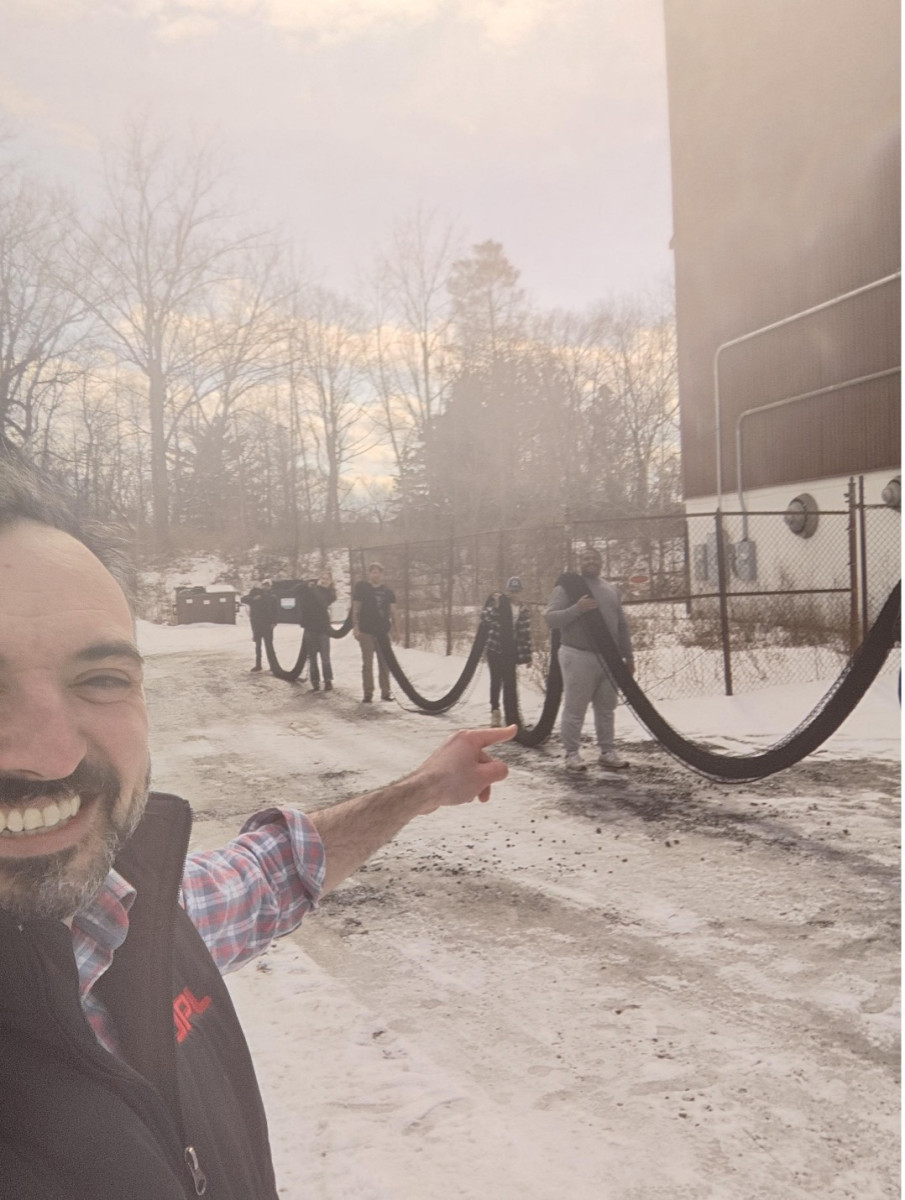
Gregory Falco, assistant professor of mechanical and aerospace engineering, points to students carrying a net into Cornell's High Volt Lab, which is being turned into an enclosed flight-testing facility.
The research will begin in computer simulations, but Falco intends to demonstrate the technology on physical drones.
Thanks to a generous gift from Anduril, his lab is transforming Cornell’s approximately 6,000-square-foot High Volt Lab into an enclosed flight-testing facility, equipped with a motion-capture system that will allow researchers to track autonomous vehicles as they maneuver and interact.
Ph.D. candidate Cameron Mehlman has been leading a student team to design, fabricate and fly swarms of drones to conduct hardware demonstrations at the lab. The project also envisions collaboration with the Air Force Research Laboratory, building on existing partnerships focused on autonomous space systems.
Although the immediate applications involve military space operations, Falco sees opportunities far beyond defense. Autonomous vehicles, agricultural robots and manufacturing systems could all benefit from technologies that allow machines to cooperate when communications fail.
“Can we still infer what's happening when we don't have perfect information?” Falco said.
That question, he believes, could lead to new ways of understanding cooperation and decision-making in systems ranging from spacecraft to economic markets.
Media Contact
Get Cornell news delivered right to your inbox.
Subscribe