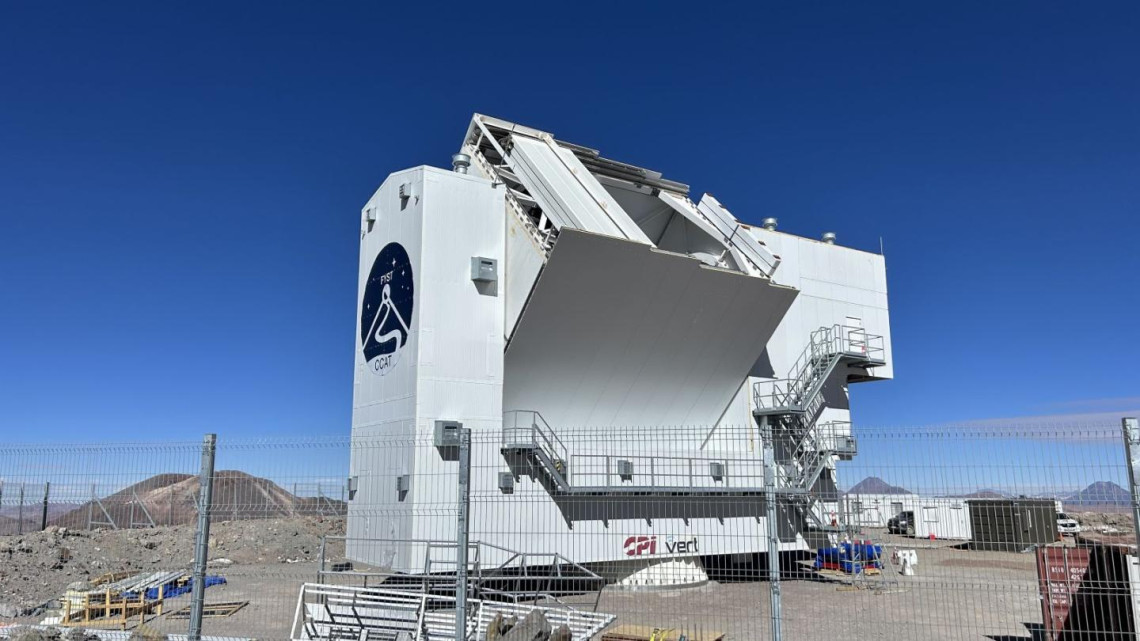
The Fred Young Submillimeter Telescope in August, 2026
News directly from Cornell's colleges and centers
Excitement mounts as new telescope nears first light
By Linda B. Glaser
As the first scientific results from the new Fred Young Submillimeter Telescope (FYST) draw nearer, enthusiasm among the scientists readying the telescope climbs ever higher.
“FYST will become the most powerful telescope in its class, facilitating important science and enlightened student involvement for many years to come,” donor and scientific adviser Fred Young '64, M.Eng. ’66, said at a September event celebrating the completion of the telescope’s construction.
The first observations will focus on the planets in the solar system to calibrate the instruments. Soon after will begin early science measurements of galaxy clusters, the largest gravitationally bound objects in the universe, according to Michael Niemack, professor of physics and astronomy (A&S) and leader of the Prime-Cam team.
Prime-Cam and mini-CHAI (led by University of Cologne) are the first scientific instruments being installed on FYST. Prime-Cam has seven instrument modules with three detector arrays per module and fits thousands of detectors on a single silicon wafer. The tens of thousands of detectors make Prime-Cam the largest submillimeter instrument ever built.
Read the full story on the College of Arts and Sciences website.
Media Contact
Get Cornell news delivered right to your inbox.
Subscribe