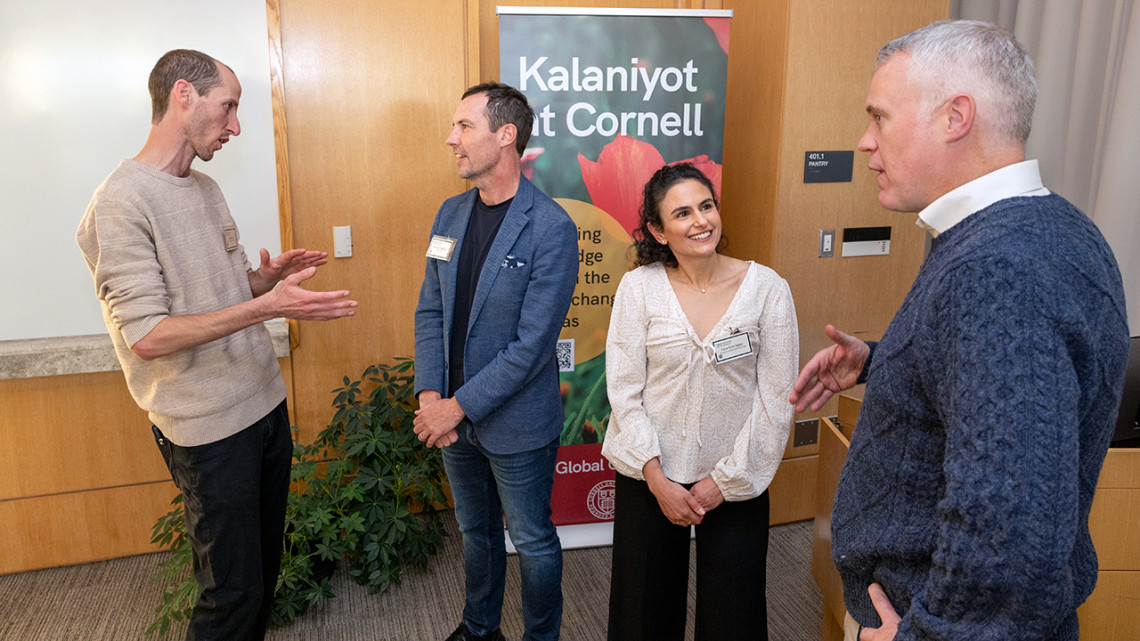
From left, Kalaniyot fellow Ohad Shalom; Benjamin Houlton, dean of the College of Agriculture and Life Sciences; fellow Eden Eran Nagar; and Peter John Loewen, dean of the College of Arts and Sciences at the Kalaniyot reception.
New program enhances Cornell-Israel academic collaboration
By Linda B. Glaser
A new initiative will bring postdoctoral and sabbatical scholars from Israel to Cornell.
The Cornell chapter of Kalaniyot, a national faculty-led initiative focused on sustaining international academic collaboration, launched at a reception Oct. 19 in the Physical Sciences Building. The new chapter joins six others at major universities across the country.
In remarks at the reception, Provost Kavita Bala highlighted Kalaniyot’s mission and its alignment with the recently released report from Cornell’s Committee on the Future of the American University.
“[The report] talks about connected communities, communities being human-centered, developing a global mission for universities, because we don’t think universities can thrive with a vision that is very closed in,” Bala said. “We believe that this kind of interaction is critical … . This relationship with Kalaniyot stands for all the great things that we think Cornell should continue to do.”
The Kalaniyot Foundation was established by faculty at the Massachusetts Institute of Technology in the aftermath of Oct. 7, 2023. Part of Global Cornell, Kalaniyot at Cornell is led by academics who aim to preserve universities as inclusive and welcoming environments for students and scholars of all backgrounds.
One of the key pillars to working on a world stage is bringing knowledge back to campus, said Benjamin Z. Houlton, the Ronald P. Lynch Dean of the College of Agriculture and Life Sciences (CALS).
“We learn so much when our scholars go broader, and when scholars come to Cornell,” Houlton said. “A commitment to that exchange of knowledge, the way it transcends boundaries and understanding, and gives rise to better humanity, is why we continue to support these kinds of projects.”
Added Yuval Grossman, professor of physics in the College of Arts and Sciences (A&S) and board chair of Kalaniyot at Cornell: “We want to enhance research excellence at Cornell through stronger ties with top-notch Israeli researchers and we want to build a supportive campus community with an international presence, fulfilling Global Cornell’s mission to connect Cornell with other parts of the world.”
The initiative is supported by alumni, Cornell and the Kalaniyot Foundation.
Faculty members serving on Kalaniyot at Cornell’s board represent six colleges and schools: A&S, CALS, the ILR School, Cornell Duffield College of Engineering, Cornell Law School and Cornell Tech.
Anyone with a Ph.D. from an Israeli university or who is a faculty member at an Israeli university is eligible to apply to Kalaniyot; neither religion nor ethnicity are considered in the selection process. Cornell’s first cohort, which is currently on campus, has three postdoctoral fellows and three sabbatical scholars and includes members from both the Jewish and Arab communities in Israel.
Postdoctoral fellow Eden Eran Nagar will work with Elad Tako, associate professor of food science (CALS), to understand how staple crops and functional foods can combat malnutrition by improving micronutrient absorption and gut health. “Just as important, I hope to lead dialogue and mentorship initiatives that strengthen long-term scientific collaboration between the U.S. and Israel,” Eran Nagar said.
Postdoctoral fellow and hydrologist Ohad Shalom will work with Meredith Holgerson, associate professor of ecology and evolutionary biology (CALS), on ponds and wetlands and their influence on ecosystems locally and globally.
Fellow Shachar Yerushalmi will study the hyperspectral imaging system developed in the lab of Katie Gold, assistant professor of plant pathology and Susan Eckert Lynch Faculty Fellow (CALS), to detect plant disease before it is visible to the eye.
Sabbatical scholar Loai Basheer’s research targets how the spotted lanternfly pest affects the chemical composition and sensory quality of grape-derived products. He’ll work with Gavin Sacks, professor and chair of food science (CALS).
Naomi Havron will spend her sabbatical working with Nori Jacoby, assistant professor of psychology (A&S), developing infrastructure to scale up developmental science. “As a Kalaniyot Sabbatical scholar, I hope to do excellent science,” Havron said, “and also to be someone students can talk to: to listen, to share my perspective and to have my own views challenged.”
Sabbatical scholar Ori Katz will continue his collaboration with Or Katz, assistant professor of applied and engineering physics in the Cornell Duffield Engineering. They work with “trapped ions” – individual charged atoms suspended in electromagnetic fields that act as building blocks for quantum computers and ultrasensitive sensors. They hope to transition their project from prototype to a fully operational system.
Linda B. Glaser is news and media relations manager in the College of Arts and Sciences.
Media Contact
Get Cornell news delivered right to your inbox.
Subscribe