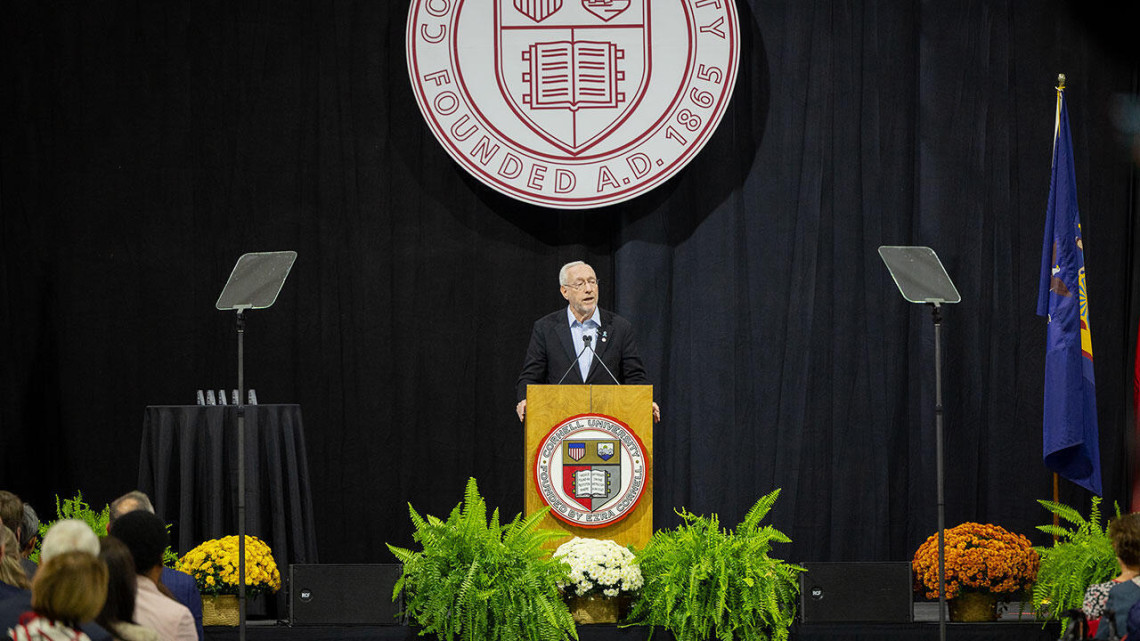
Cornell President Michael I. Kotlikoff delivers his 2026 State of the University address Oct. 15 in Meinig Fieldhouse.
State of the University: ‘The challenges that we must rise to meet’
Below is the full text of President Michael I. Kotlikoff’s 2026 State of the University address, delivered Oct. 15 in Meinig Fieldhouse:
Good afternoon everyone, and welcome to this year’s Joint Annual Meeting, held for the first time in this beautiful new Meinig Fieldhouse, named for our beloved Board Chair Emeritus Pete Meinig ’61. And I want to thank all of the alumni and friends who came together and decided that on a campus famous for winters that are long, dark, cold and wet, our hardworking community and athletic teams really needed somewhere to play and practice that’s big, bright, warm and dry.
In the new Meinig Fieldhouse, the recreational activities, university clubs, intramural leagues and varsity programs that mean so much for our community’s wellness can keep running – metaphorically and literally – all winter long.
Like so much else at Cornell, the Meinig Fieldhouse was made possible by the incredible commitment and dedication of our Cornell community – the alumni, parents and friends who take so much pride in our university and its achievements.
Who have come together, in so many ways, over the past years, To Do the Greatest Good.
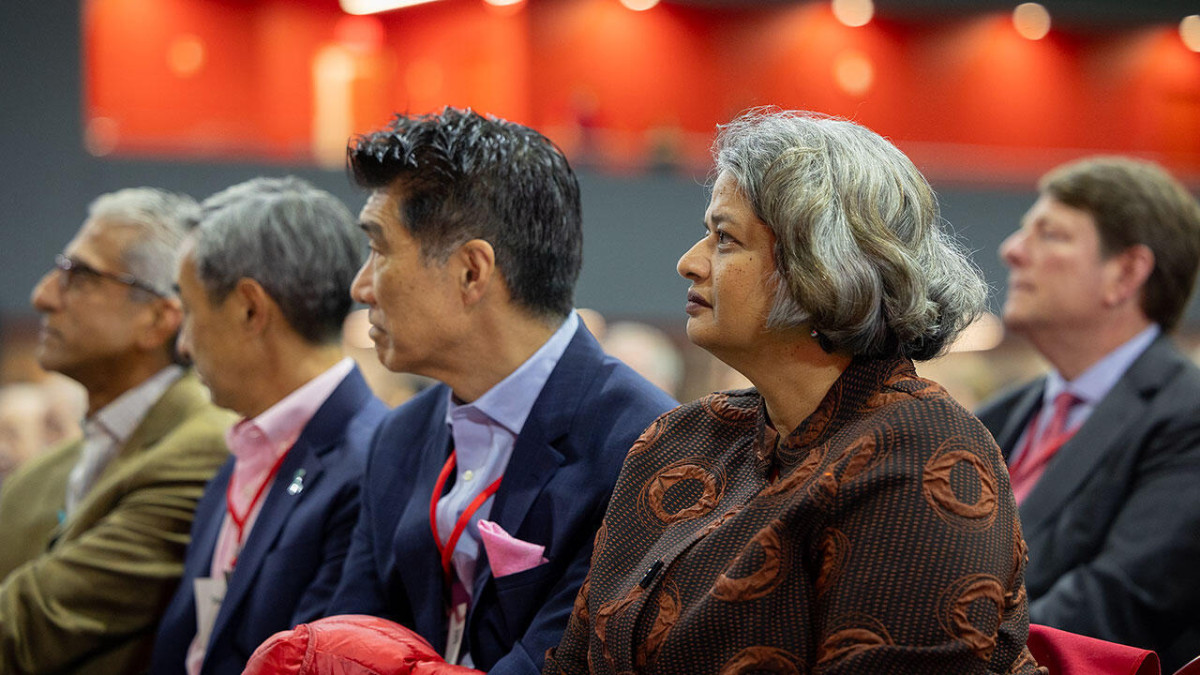
Provost Kavita Bala listens to the State of the University.
And have come together, here in Ithaca, at one of the most difficult moments in Cornell’s 161 years.
I had a plan, up until a few weeks ago, for what I was going to say to you this evening.
I was going to talk about the many crises and challenges we’ve overcome together over the past year – the enormous work we’ve done across our schools, colleges and campuses to adapt to a changed reality, and prepare for an unknown future.
How we kept our research – on everything from propulsion systems to cancer treatments to flood-resistant wheat – moving forward, through nine months of federal funding freeze; and the agreement we reached that restored that funding, while protecting Cornell’s independence.
How we’ve rebuilt our operating model from the ground up, to ensure a more resilient Cornell; and the enormous progress we’ve made at Weill Cornell Medicine, to enable new discoveries and new cures, better medical education and better patient care.
About the work that goes on day after day, across and beyond our campuses – work that transforms lives, powers our economy, advances our national strength and safeguards our common future.
And the strategic work that we’ve undertaken to position Cornell to lead, in restoring public trust and “doing the greatest good.”
That isn’t a speech I can give this evening.
Our community is reeling. From reverberations of the appalling assault on Jane Doe by members of our community; and everything the events of the past weeks have brought to the center of our conversation, and our attention, at Cornell.
On behalf of our entire community, I want to again apologize to Jane Doe, and to the many women I have spoken to, who have shared with our community, and with me, personally, their experiences: of sexual assault at Cornell, at other universities, and in other spaces. I am sorry, for all of the ways that you were failed.
And I am deeply grateful to everyone who has come forward, who has shared their stories and their understanding. Enough is enough. And we must do better.
This is the beginning of what will become the defining effort of the rest of my presidency. It comes at a point of major and historic shift at Cornell.
While the place we are in right now, as a community, is not anywhere we want to be, perhaps it is where we have to be, where we must be, in order to move forward.
And so, I want to take the time I have this evening to talk to you, our community, about where we are, and the larger lessons we’ve taken from what has become a global conversation.
And I want to talk as well about the larger lessons I’ve taken, over the time I’ve served as Cornell’s 15th president – on where we are as a university and the challenges that we must rise to meet, in a changed and changing world.
I’ll start with two truisms, both of which bear repeating:
That what you see in your feed or hear in a podcast is generally not what you’ll see or hear, when you’re living, working and learning on this campus.
And that simple narratives are rarely an accurate reflection of complex human realities.
As the philosophers have it, “The map is not the territory.”
Those simple narratives, in the age of social media and AI, are everywhere – while the work of understanding complex human realities and finding answers for complex human problems has not gone far enough.
That work still requires listening and leadership, time and skill, patience and expertise – and the kind of thoughtful education that we have been providing at Cornell for 161 years.
The kind of education that transformed your lives and mine – and is essential for our students and our nation, our democracy and our shared future.
I’ve been at Cornell for 27 years.
As Anne (Smalling, chair of the Cornell Board of Trustees) said, I’ve been a faculty member, a department chair, a dean and a provost; I’m a Cornell husband, and a Cornell dad.
I love this place.
It’s home.
And the reason I love it is probably the same reason all of you love it.
Whether you’re on our campus every day or live halfway around the world, Cornell is home.
Always part of who you are, because of the part it played in making you who you are.
Wherever you came from, Cornell gave you more than a credential: It gave you the knowledge, the confidence, the perspective and the community that transformed your life.
Our task, as Cornell leadership, is ensuring that this university continues to give that transformational education to students today and generations to come.
The kind of education Ezra Cornell described to his granddaughter in the simplest possible terms: “to educate good and wise women and men.”
Or, as A.D. White said, in his loftier prose: an institution to fulfill the yearning, for better things in our beloved country.
The education, and institution, our nation needs, now, more than ever before.
For 161 years, we at Cornell have taken enormous pride, both in the work of our campus and in its outsized impact; in the numbers of our graduates who go on to become leaders and role models at the highest levels, across every field and discipline: university faculty, elected representatives, government officials, military officers and respected professionals.
We’ve taken pride in their achievements, and in the reputation we’ve earned: as a place of hard work and open minds; integrity and clarity; civic responsibility and care for the common good.
Where we stand up for our values and find strength in our differences. Where we respect everyone’s rights, even when we don’t agree with what they say. And where we educate good and wise women and men, able to make the future better than the past.
I’ve spent much of the past weeks talking to our students, individually and in small groups, and listening to our faculty, our provosts and our deans, as well as our alumni, our families and our staff. We’ve talked, of course, about Jane Doe: about the larger issues of sexual assault, and what it would take for women to feel safe. About what we’re doing wrong, and what we, as university leadership, need to know to begin to set things right.
Much of what they’ve told me has been difficult to hear. But they have also filled me with enormous pride in their insight, their clarity and their readiness to tackle the issues we face now, as a community, as we have so many others: thoughtfully, with evidence and care for each other.
We live in a world of eroding behavioral norms – where sexual assault is no longer a disqualification from leadership, and public figures speak and act in ways unthinkable a generation ago.
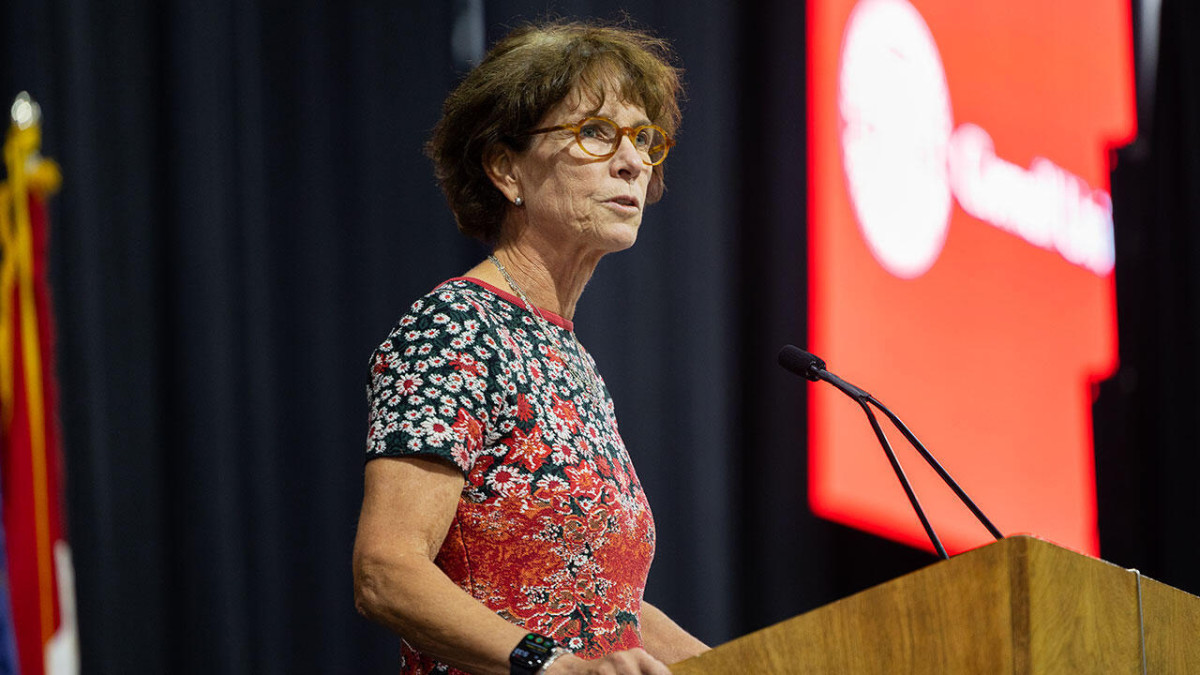
Cornell Board of Trustees Chair Anne Meinig Small ’87 delivers remarks before Kotlikoff.
We do not exist apart from that world. And ensuring that Cornell remains a place where our graduates are held to a higher standard is going to require a hard look at some of the places and ways where those standards aren’t being upheld at Cornell.
One of them is the fraternity system. It’s been part of Cornell since the beginning, and it’s brought an enormous amount of benefit to generations of Cornellians. A.D. White was a member, and a supporter, but to quote him on the topic, “Like most human organizations, they produce both good and evil.”
A third of Cornell undergraduates are part of Greek life. They belong to more than 50 fraternities and sororities. All of them are different. At their best, they bring community, connection and lifelong friendships.
But more and more in recent years, we’ve seen a disturbing culture emerge in some of these fraternities. What this moment has brought us is the recognition across our community, including our alumni who benefited so much from Greek life, that we have to hit reset, and we have to do it now: with measures that will keep our students safe, and give us the time to understand where we are, look more deeply into how we got here, and find ways to do better.
That will take time. It will take effort. It will mean discussion, debate, disagreement and mistakes. It will mean inviting the input and the contributions of every part of our community and taking them seriously; looking beyond what people are doing, and understanding why; understanding the social contexts of the behavior we’re seeing, and how to provide alternatives.
None of that lends itself well to a world of easy outrage.
Complex realities don’t fare well on protest posters or in social media.
So it’s also our job to be thoughtful and strategic about communicating what we’re doing, and why; and why simple fixes won’t yield solutions in this complex human reality.
Which brings me to the point I had planned to end with, in the version of this speech I envisioned a month ago.
And that is the mission we’ve had for 161 years – of education, research and impact. Educating citizens to lead and thrive in a democracy – and bringing better things, to our beloved country.
Higher education in America is at a crossroads. And I don’t mean only Cornell. We are in a crisis affecting the entire landscape of higher education: all of the universities that have provided knowledge, expertise, innovation and creativity in this country for so long.
The traditional institutions and models of the university are at risk in a world of social media, artificial intelligence and new technologies; ruptures in our federal partnerships and funding; and an erosion of public trust that extends past our universities into nearly every institution of public life.
That’s why we’ve spent the past year deeply engaged across our community in the hard and serious and complex work of planning our path forward in this new and more volatile reality, through the work of our Committee on the Future of the American University. Using evidence and expertise to understand the challenges that face us – what our nation needs from our universities and what our universities need to do to meet the needs of our democracy.
We live in a country where choosing a side and condemning the other is easier than ever – and the path to solutions that demand understanding, context and compromise is far harder.
Where it takes tremendous courage to dissent, to go against the prevailing tide, when something isn’t right – whether it’s in law, or government, or the workplace, or down the hall.
That is the courage we need to teach.
And we won’t teach it through quick fixes or easy answers.
We can only get there the hard way and the human way.
By teaching our students what it means to live in a community and contribute to civil society.
The responsibility we have to protect and care for each other, particularly when we are at our most vulnerable.
Conveying patience, judgment and humanity in a world that moves at machine speed, demands easy answers and rewards instant rage.
Infusing our students with responsibility – what we owe to each other.
And educating good and wise women and men: who prioritize the common good, cherish democracy and the rule of law, and can work together on those complex problems that do not come with simple solutions.
And while activism and passion can change the world – they only do so when that passion is turned to purpose.
When we do the hard work of our human world.
The work of Cornell – To Do the Greatest Good.
Media Contact
Get Cornell news delivered right to your inbox.
Subscribe