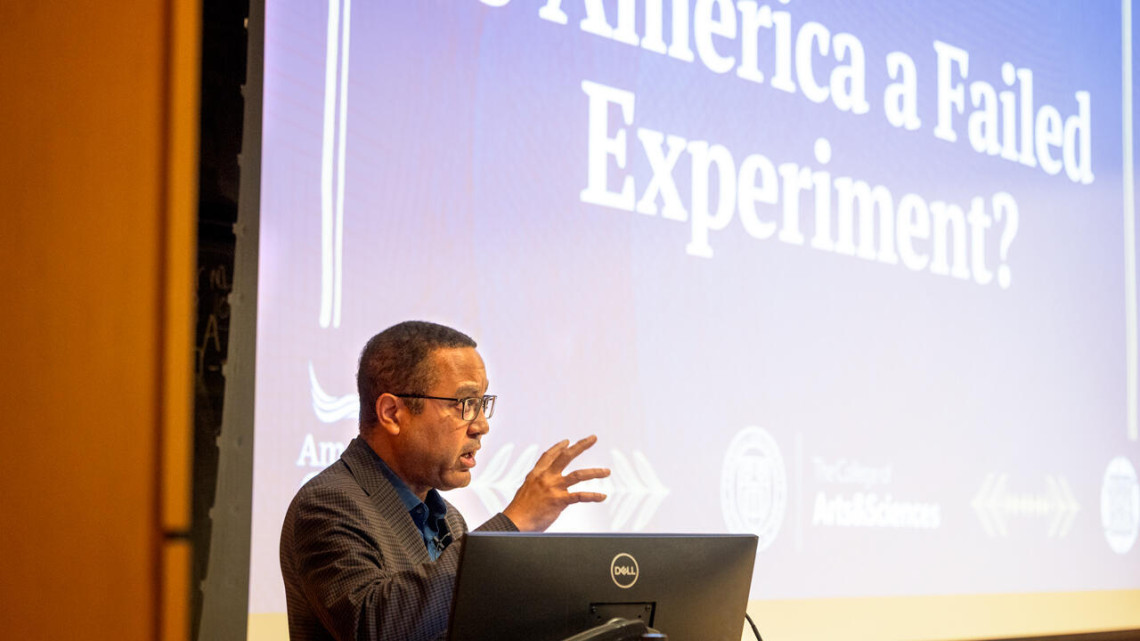
New York Times columnist John McWhorter speaks at Klarman Hall.
NYT columnist: U.S. democracy’s progress outweighs ‘failed nation’ narrative
By Kathy Hovis
Perusing academic journals or listening to extremist activists, it might be easy to surmise that America is irredeemably broken, that the best course of action might be to “blow up” U.S. democracy and start over.
But linguist and New York Times columnist John McWhorter argued, in a Nov. 2 talk, that mentality discounts the nation’s progress, albeit slow, and the many reasons that democracy is worth saving.
His talk, “Is America a Failed Experiment?” held in Rhodes-Rawlings Auditorium in Klarman Hall, was part of the America250 series of events hosted by the College of Arts and Sciences. McWhorter, associate professor of linguistics at Columbia University, served as a faculty member at Cornell in the 1990s.
During his time on campus, McWhorter also met with students from the Cornell Daily Sun, participated in a debate sponsored by the Cornell Political Union and attended a linguistics class.
“What higher wisdom seems to be saying is that this experiment, where a nation is founded on liberal principles, and not nationality or creed, has failed, as opposed to the monarchies and theocracies and dictatorships that have been and still are common,” he said. “I find that a daring position, but I don’t want to believe that the American experiment has all been a failure.”
In his talk, McWhorter argued that doomsday scenarios of America’s future have three main problems. They rely on overly simplistic explanations or blaming groups of people, usually white people or rich people; they focus on continued inequality in the country rather than seeing signs of America’s social progress; and they adopt an “anti-modern” mentality that discounts America’s inventions, artistic achievements and the waves of immigrants who have come to the U.S. for its promise of a better life.
“To say that all of the people who have wanted to come here forever are fools, that some people think they must not like it when they get here, or if we could have informed them in Nigeria or in Thailand then maybe they wouldn’t have come – I think that’s selling us a little short,” he said. “And I think that anyone who says that America is a failed experiment knows that on some level there is a cognitive dissonance.”
McWhorter cited research from the Progressive Policy Institute, which studied articles between 2022-2024 in American Quarterly, a journal of American studies. He found that 80% of the journal’s content was critical of America, 20% was neutral and no articles offered a positive portrayal of the American experience. He conducted a similar nonscientific study himself in the 1990s and found the same results: lots of condemnation of the country without suggestions on how to improve it.
“It’s off and it’s not very constructive and we see a lot of this in academia in general,” McWhorter said, citing examples of outlier theories in math and physics education.
An underlying problem, he said, is that Americans are uncomfortable with the idea that battling social inequality and improving the country is a slow process, he said. He believes that American institutions will rebound after President Donald Trump’s drastic spending cuts and that the country will continue to make progress toward universal healthcare, he said.
“We’re like a drunk who is going forward, lurching and hitting a wall then getting back in the middle and then hitting a wall again,” he said. “That person at least stands up and gets a certain distance before hitting a wall again. That is what societal change is like.”
During a Q&A, McWhorter responded to questions about what forces in America believe the current system should be dismantled.
“I hate to say that I do mean the DSA [Democratic Socialists of America] – and they’re not going to put it this way – but what they want is to completely blow things up, not literally, but to change procedure in a way that would be unheard of in the American experiment,” McWhorter said. “The MAGA right are doing what they’re doing in the name of apple pie white patriarchal America. They don’t see themselves as starting this all over again. They think if we go back to 1955, we’ve kind of hit a system restore.”
McWhorter ended by discussing the song “Rehearse” from the musical “1600 Pennsylvania Avenue,” concluding that although America’s shortcomings deserve scrutiny, they don’t outweigh evidence that the nation’s institutions and citizens remain capable of change and improvement.
“To say that America is a disaster feels good, but it’s an abdication of responsibility,” he said. “The U.S. is imperfect but we’re always in rehearsal.”
Other upcoming events in the America250 series include “Language, Memory, Future,” a two-day celebration of America’s languages Nov. 5-6, and “Bridging Urban-Rural Divides in the United States: A Conversation with Governor John Kasich,” set for Nov. 19.
Kathy Hovis is a writer for The College of Arts and Sciences.
Media Contact
Adam Allington
Get Cornell news delivered right to your inbox.
Subscribe