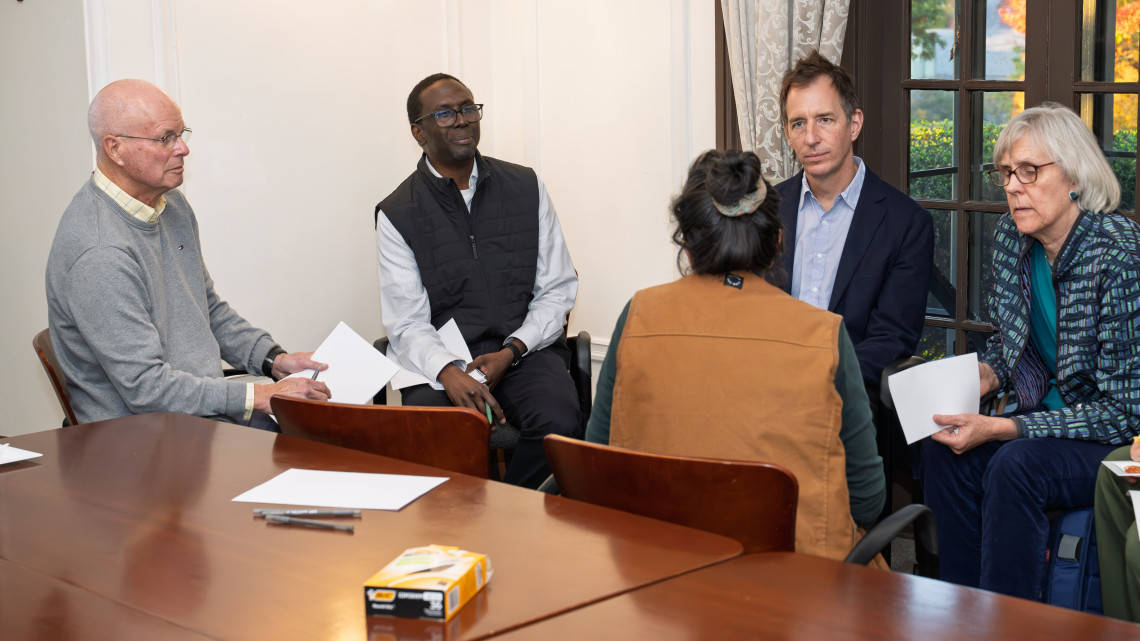
(From left to right): Professors Stewart Schwab, Oumar Ba, Nelson Tebbe, Mildred Warner, and Natasha Raheja.
News directly from Cornell's colleges and centers
Scholarly Leadership to Protect and Strengthen Democracy
By Eileen Korey
As Nelson Tebbe ponders the work ahead for the Rule of Law, Rights, and the Democratic Order pillar in the Cornell Center on Democracy, he envisions an opportunity for scholars to support the work of those on the front lines in the fight for democracies worldwide.
“What is our comparative advantage as scholars? What can we bring to the strengthening of democracy that other people can’t?” asked Tebbe, associate dean for academic affairs and the Jane M.G. Foster Professor of Law. “We help the country most when we perform our role as intellectual leaders at the highest level. We can draw together the resources to articulate the ideas that can develop policies, challenge assumptions, and drive change.”
The Rule of Law, Rights and the Democratic Order pillar aims to produce large-scale initiatives aimed at strengthening rule-of-law institutions in the United States, and evidence-based tools and policy frameworks for policymakers, public officials and civil society organizations.
Tebbe is excited about engaging thought leaders in government, philosophy, history, economics, and public policy in a series of Democracy Theory Workshops. The inaugural session on Nov. 9 features Stanford Law School’s Evelyn Douek on "The Unfulfilled Promise of Chilling Effects Doctrine," and a discussion about protecting citizens from retaliation or coercion and other chilling effects on free speech.
“We need to question what we mean by democratic order, or perhaps we should speak of democratic orders in the plural,” said Oumar Ba, assistant professor in the Department of Government in the College of Arts and Sciences, and Tebbe’s co-faculty lead in the pillar. “We should allow ourselves to think critically about what forms of democracy have emerged and creatively about what forms will emerge in the future. Democracy is not a singular destination but rather a form of governance which may look different in different spaces across time.”
A first-generation college graduate who emigrated to the United States from Senegal just months before 9/11, Ba sees democracy as an evolving concept. “There is no single articulation of democracy. We talk about plurality and participation of the citizenry. But what happens when some people come to power and use it to subvert the democratic process itself? Are we still in a democracy? These are difficult conversations we must have right now.”
Both Tebbe and Ba believe the interdisciplinary engagement of scholars will have meaningful impact on the struggle to protect and advance democracies. “We can help articulate the ideas that support others working in Washington, D.C., or in the judicial system,” said Tebbe.
“We are engaged in the pursuit of truth in scholarly work,” said Ba. “It is through the confrontation of ideas and perspectives that we get closer to truth.”
Media Contact
Get Cornell news delivered right to your inbox.
Subscribe