Shape-shifting seaweed yarn, robotic knits design the future of on-skin tech
By Susan Kelley, Cornell Chronicle
The yarns made of seaweed, shrimp shells and gelatin concocted in the Hybrid Body Lab seemed to have serious defects. When exposed to water, the seaweed yarn swelled, the shrimp-shell yarn elongated in acidic conditions and the gelatin yarn disintegrated all together.
“But then we thought, ‘Maybe this could be an interesting effect,’” said Cindy (Hsin-Liu) Kao, associate professor of human centered design and director of the Hybrid Body Lab in the College of Human Ecology, who created the yarns with her students.
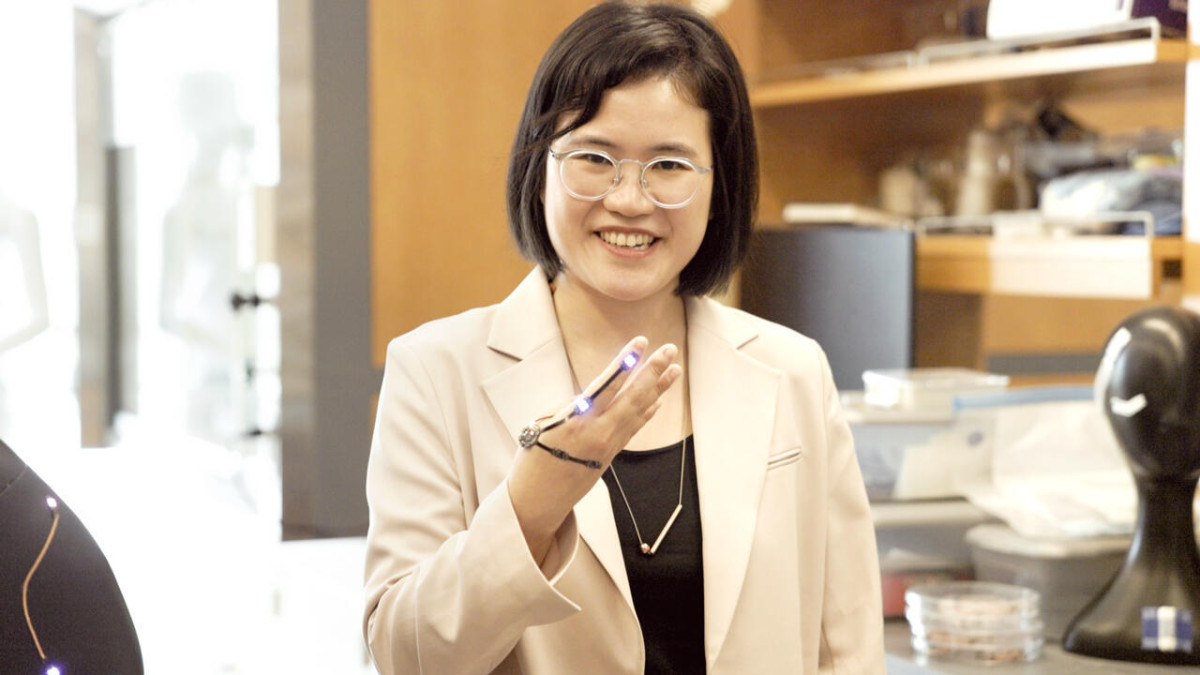
Cindy (Hsin-Liu) Kao, associate professor of human centered design, wears a device that tracks the movement of her hand in real time. She made it in a few minutes using modules from SkinLink, her lab’s toolkit for easily creating circuitry on the skin.
Their ability to imagine those supposed defects as design features resulted in AquaWeave, a library of woven textiles that morph into tubes, flaps, domes and extensions, some with openings created by the dissolving yarn – all with implications for human-computer interfaces.
“Let’s say your smartphone could change its shape. Maybe now it’s in the shape of a phone, but later, you wanted it to give you a neck massage. It could then morph into a massage pad,” said Kao, an expert in crafting technology for the body. “This is a concept that is very important in our field, and people are examining a lot of different methods.”
Using centuries-old weaving techniques, materials like living plants, and robotic textiles and smart tattoos, Kao is expanding the definition of wearable tech. Her on-skin devices conform not only to the complex topography of wearer’s body but also to their social and cultural identities.
Kao’s advisee, Jingwen Zhu, Ph.D. ’26, now assistant professor of design at University of California, Davis, is lead author of the AquaWeave research and presented it Nov. 4 at ACM UIST 2026, a premier conference in human-computer interaction, in Detroit, Michigan.
Rather than focusing on a specific bioyarn material or weave pattern, the design menu systematically explores how different weave structures can produce distinct morphing behaviors, Zhu said. “I think this is particularly exciting because it shifts the focus from individual material demonstrations to a broader design space. It opens opportunities for researchers and practitioners to develop their own patterns and explore new possibilities for liquid-activated morphing textiles.”
The team is thinking about technologies that have a very intimate relationship with the body, Kao said. “How do we create them, so that they can also reflect the wearer’s personal identity, and the greater cultural context in which we live in?”
More territory to explore
In her lab, Kao leaned over her workbench and began building with the wearable tech equivalent of Lego bricks.
In just a few minutes, she made a device that wrapped snugly around her index finger and tracked the movement of her hand in real time.
Worn by an elderly person, the device could send a text alert if the person falls. Other modules can make a filigree necklace that improves wearers’ posture by vibrating when they slouch, and a face tattoo that acts like a flashlight and automatically brightens in a darkened room.
The modules are part of SkinLink, a toolkit for easily creating circuitry on the skin that can conform even to tricky body parts like elbows and knees. Before Kao developed SkinLink with Pin-Sung Ku, a doctoral student in her lab, it took experienced researchers hours to create a similar device, she said.
“There are just so many things you can do with it, because now it has become very easy put these sensors and actuator pairs together instead of having to fabricate one single device,” she said.
Current wearables are usually designed for the wrist. But there’s so much more territory to explore, she said, pointing to a yoga mannequin doing a handstand with a SkinLink device snaking around its back and thigh. “A lot of our work is thinking about some underexamined body locations,” she said.
Ancient inspiration
To make her devices fit those locations, she and her lab often turn to ancient crafts.
In 2018, Kao visited a 1,200-year-old Nishijin weaving workshop in Kyoto, Japan that is now in its ninth generation of weavers. The skills she witnessed there inspired her to think about how to integrate craft and expressiveness to on-skin interfaces.
When she joined the Cornell faculty in 2019, she learned how to weave from textile artists at Luna Fiber Studio in Trumansburg, New York, and also learned digital machine knitting, adapting knitting and weaving techniques to integrate circuitry into on-skin devices.

UV Scale is a set of flexible resin-printed scales that change color under UV light, made by tattoo artist Joe George during a 2023 artist residency at the Hybrid Body.
Kao and her team used a centuries-old weaving technique called Spanish lace to create the finger-joint regions of WovenProbe, a bandage-like device that detects changes in the wearer’s hand motions. The technique creates openings in the weave that allow the joints to move freely. That makes it easier for the wearer to go about their everyday activities unimpeded – an important component to making on-skin tech wearable.
“There are actually seven very small printed circuit boards in there, and over three dozen wires that are connecting these boards that are woven in,” Kao said. “It is a very intricate weaving process. What enabled us to do this was learning from a lot of weaving patterns dating back centuries, to solve some of the issues of these on-body devices, and to have circuitry on the body in a comfortable manner.”
Collaborating with artists
In addition to leveraging unusual techniques and materials, Kao also seeks out to unusual collaborators: artists of all kinds who she invites to experiment with her lab’s technologies.
She’s been collaborating with artists since 2021, when she received the National Science Foundation’s (NSF) Faculty Early Career Development Award, which in part helped fund an artist residency program. “I was trying to convince the field that it’s very important for these on-body technologies to have perspectives outside of STEM (science, technology, engineering and math), particularly from people who are experts in art and design on the scale of the body,” she said.
For the past four years, Kao has hosted artists who specialize in tattoos, make-up, nail art and hair. Each joined the Hybrid Body lab for up to two months, met students and brainstormed about how to integrate the lab’s technologies into their practice.
“A goal of mine was to rock the boat a little bit, because in academia, you can just get very comfortable working and thinking in a certain way” Kao said.

EdemaFlex, with more than three dozen actuators across all five fingers and the palm, aims to reduce swelling for people suffering from edema. It was developed by Cindy Kao, associate professor of human centered design, and her team at the Hybrid Body Lab.
Most recently, hair artist Lauren Hooks created “Dancing Hair,” inspired by the lab’s Knitdema robotic textile. Hooks braided a wearer’s hair with green aventurine beads and integrated shape memory alloy coils that send programmed, rhythmic electrical signals to trigger compression within the coils and activate acupressure points at the head’s temples, apex and base.
In 2023, tattoo artist Joe George created the on-face flashlight with the Hybrid Body Lab’s technology. He also made Thermaldermal, a flexible strip of black heating coils that can be manipulated into a tattoo-like line drawing and emits heat when applied to the skin. He envisioned it as a “tramp stamp” tattoo, a more artistic alternative to traditional square or oval heating patches and “a wearable patch that is both physically and conceptually hot.”
The residencies, Kao said, are “an important way of bringing together two very different cultures – academic culture versus body art culture – and learn from each other.”
For the AquaWeave project, the team recruited weavers from a conference in Norway celebrating the 30th anniversary of the TC2 jacquard loom. About the size of a large upright piano, the loom is computerized, manually controlled and designed specifically for creators who want to do rapid product development. It enables Kao and her students to weave textiles with complex circuitry, wiring and biodegradable yarns.
“It’s much quicker for prototyping and trying weird things,” Kao said.
For the AquaWeave project, the team first did tests to characterize the properties of each kind of yarn – how they each morphed and under what conditions – and created parameters and prototypes to figure out how to best work with the materials. Then the weavers used the bioyarns to make textiles leveraging the yarn’s design features.
One particularly interesting observation, Zhu said, was how familiar they were with using water in their existing textile practices, from dyeing and washing to finishing. “This familiarity made liquid activation feel like a natural extension of their existing practices, rather than an entirely new form of interaction,” she said. “It shows the potential of liquid activation as an intuitive actuation mechanism for bio-integrated textiles.”
One weaver created a ribbed texture from the seaweed yarn’s tendency to swell; another used her textile’s tendency to curl to create a pattern; a third created a three-layered textile with bioyarn in the middle layer that deformed and made the internal structure visible.
“They bring a deep understanding of the craft of weaving and a remarkable level of material intuition,” Kao said of the weavers. “We love seeing the creative ways people outside our fields work with these bioyarns. We learn so much from them, too, and that kind of cross-disciplinary exchange helps move the field forward.”
Additional co-authors for AquaWeave are doctoral student Eddie Zhu, Emily Fan ’26, Megan Wu ’27 and Samantha Chang ’26.
Media Contact
Get Cornell news delivered right to your inbox.
Subscribe