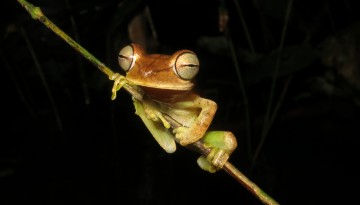
A fungal disease that afflicts amphibians has led to the greatest loss of biodiversity ever recorded due to a disease, according to a paper published in Science.
The university has created the Cornell Center for Social Sciences, and a faculty implementation committee will make recommendations for the creation of an organizational structure integrating public policy areas and the creation of “superdepartments.”
Ascribe Bioscience has become the first company based on technology developed at the Boyce Thompson Institute to receive a National Science Foundation Small Business Innovation Research grant.
In his new book “Infinite Powers: How Calculus Reveals the Secrets of the Universe,” mathematician Steven Strogatz explores the history, big ideas and applications of a subject that is essential in everything from how smartphones operate to the latest innovations in medicine.
More than 200 alumni are expected to return to campus April 11-12 for the Entrepreneurship at Cornell Celebration, which will include recognition of the Cornell Entrepreneur of the Year.
The Cornell China Center has announced eight China Innovation Awards to interdisciplinary teams of Cornell faculty, aimed at jump-starting collaborative research and developing research teams.
The new season of the “What Makes Us Human” podcast series from the College of Arts and Sciences is titled “What Does Water Mean for Us Humans?” and explores the relationship between humans and water.
A team led by Cornell astronomer Lisa Kaltenegger has published a catalog of 1,822 stars that the new Transiting Exoplanet Surveying Satellite will be able to scan for possible Earth-like planets in their orbits.
Joshua Berman ’91, a former pre-med student turned government major and lawyer, visited campus in February for a career conversation hosted by College of Arts and Sciences Career Development.