"40 Years of Cosmic Discovery: Celebrating the Voyager Missions and Humanity’s Message to Space" begins with a panel at 8 p.m. Oct. 19 in Cornell’s Bailey Hall.
On the brisk autumn morning of Wednesday, Oct. 8, 1997, Cornell students, faculty and staff strolling by McGraw Tower noted an unusual sight: a large pumpkin impaled on the spire 173 feet up. The question remains: Whodunit?
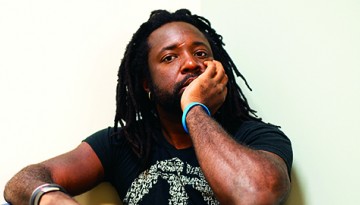
Award-winning Jamaican historical novelist and educator Marlon James, author of “A Brief History of Seven Killings,” will read from and discusses his work Oct. 12 in Rhodes-Rawlings Auditorium, Klarman Hall.
Cornell computer scientists have formed the Center for Data Science for Improved Decision-Making to find ways to handle data responsibly and use it as a resource for the public benefit.
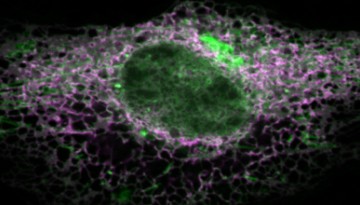
Researchers in the Department of Chemistry and Chemical Biology have improved an imaging method they developed in order to better track activity of a cell signaling enzyme that plays a role in cancer cell metastasis.
Can scarcity – or even just the perception of it – lead someone to discriminate against blacks? The answer is yes – if resources are scarce, and the person is unmotivated to act without prejudice, says psychologist Amy Krosch.
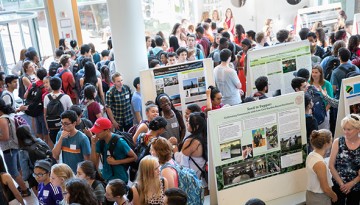
About 30 students from the Cornell Commitment office – Meinig scholars, Rawlings research scholars and Cornell Tradition fellows – presented posters and panel discussions Sept. 27.