Cornell’s global reach expands with the inaugural session of the East China Normal University (ECNU)/Cornell University Summer School in Theory (ECSST), July 18-22 in Shanghai.
The key to curing multiple sclerosis may well lie in the mysterious signaling of lipids, a major component of cells, says Cornell chemist Jeremy Baskin.
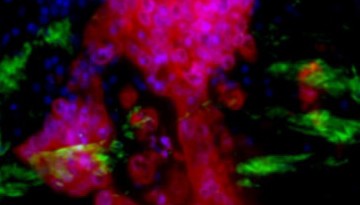
Cornell researchers have helped develop a recellularized human colon model that could be used to track the pathogenesis of colon cancer and possibly gain insight into its spread to other organs.
Three pairs of early career scientists have been named the inaugural Mong Family Foundation Fellows in Neurotech. They will work jointly under the mentorship of faculty across Cornell to advance brain technologies.
Cornell will host the Conference in Laboratory Phonology, an international meeting for researchers taking experimental approaches to the study of human speech sounds, July 13-17. It will addresses sounds in human language as part of a linguistic, cognitive and communicative system.
Single-strand DNA sequencing method used for analyzing ancient remains applied by Cornell researchers to sequencing of cell-free DNA taken from plasma of transplant patients, resulting in greater yield of ultrashort cfDNA.
Since Sofia Aumann ’19 uncovered the complicated issues behind human sex trafficking as she worked on a research project, she has supported schooling for girls in developing nations.
NASA’s Cassini and Huygen’s missions have provided a wealth of data about chemical elements found on Saturn’s moon Titan, and Cornell scientists have uncovered a chemical trail that suggests prebiotic conditions may exist there.
Anne R. Kenney, the Carl A. Kroch University Librarian, has announced she will step down from her position April 1, 2017, to begin a six-month research leave, after which she will retire.