Some of Cornell's best scientists working on how the brain works will gather Sept. 29 for the Cornell Neurotech Mong Family Foundation Symposium. It features three alumni winners of the 2015 Brain Prize.
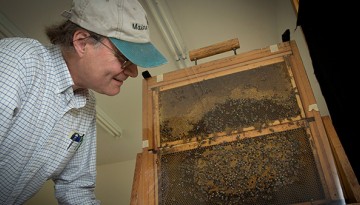
Thomas Seeley and four engineers from Georgia Tech will share the Fifth Annual Golden Goose Award for the "honeybee algorithm," which adapted basic bee research to the $50 billion web hosting industry.
At Wednesday's faculty Senate meeting, Interim President Hunter Rawlings discussed his desire for the university faculty to review the undergraduate curriculum with an emphasis on the value of a liberal education.
Using low-amplitude vibration, researchers show the ability to control the flow rate of a dense liquid. This discovery has potential applications in advanced technology fields, including 3-D printing.
2015 Nobel Prize winner Svetlana Alexievich spoke at Statler Auditorium on Sept. 12 about her nonfiction techniques to capture many people's voices to produce historical narratives.
Twelve faculty members from seven departments have been named Engaged Cornell Faculty Fellows for 2016–17. The program supports faculty who do community-engaged teaching or research.
Cornell's Homecoming 2016, Sept. 23-24, will start with a bang – the popular fireworks and laser light show – and continue through a weekend of fun events for the university and area communities.
Professor Marilyn Migiel has studied the 14th-century Italian author Giovanni Boccaccio for years. Her newest book explores how one of Boccaccio's most famous works challenges readers to think.