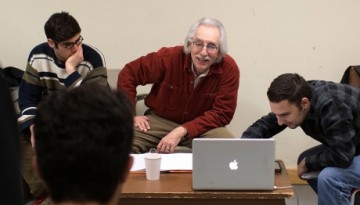
Hirokazu Miyazaki, professor of anthropology and director of the Mario Einaudi Center for International Studies, spoke to the Chronicle about an upcoming conference and its theme of collaboration.
Professor of performing and media arts Bruce Levitt was awarded Cornell's Engaged Scholar Prize for his community-engaged work, including facilitating a theater group at Auburn Correctional Facility.
Rebecca Stoltzfus has been appointed vice provost for undergraduate education as of July 1, and Julia Thom-Levy has been named provost's fellow for pedagogical innovation as of Aug. 1, Provost Michael Kotlikoff announced.
Climate change and other 21st-century environmental dangers put us all at risk, and technology alone does not hold the answers. Humanists at Cornell offer a critical perspective on solutions.
Twenty-one students from across campus traveled to Japan on a a winter break study tour funded by the Japanese government as a cultural exchange exposing American students to the country.
Fifteen Cornell students received Fulbright U.S. Student Awards to conduct research or teach abroad in 2016-17, according to the Mario Einaudi Center for International Studies.
Katja C. Nowack, Cornell assistant professor of physics in the College of Arts and Sciences, has been selected by the Department of Energy to receive significant funding for research over five years.