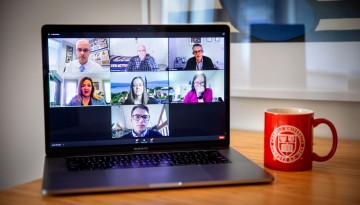
In the sixth Cornell Leadership Sessions video, President Martha E. Pollack and Dr. Gary Koretzky, vice provost for academic integration, discuss the recent cluster of cases on the Ithaca campus, the need for continued vigilance and plans for a hybrid spring semester.
Years before COVID-19 turned into a global pandemic, biomolecular engineer Susan Daniel was already looking for ways to defeat it. Now she’s expanding her coronavirus studies, blending engineering with virology and data science.
The fourth annual Weill Cornell Medicine Dean’s Symposium on Entrepreneurship and Academic Drug Development drew 125 attendees and served as an urgent reminder of the importance of biomedical innovation.
Entitled individuals were less likely to report that they were following COVID-19 health guidelines, according to a new paper co-authored by Emily Zitek, associate professor in the ILR School.
Cornell food scientists confirm that the grain teff helps the stomach and enhances the nutritional value of iron and zinc, according to a new modeling method.
Disease-specific training may improve home care workers’ job satisfaction and confidence caring for patients, according to new research from Weill Cornell Medicine and the ILR School.
The “One Health” approach is perfectly suited to tackling the COVID-19 pandemic, the most serious public health crisis in recent history, Cornell researchers said during the university’s COVID-19 Summit, a virtual event held Nov. 4-5.
A Cornell-led collaboration developed a 3D printing technique that creates cellular metallic materials by smashing together powder particles at supersonic speed.