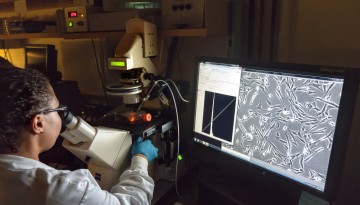
A new male fertility test based on Cornell research could help predict which men might need treatment and which couples might have success with different forms of assisted reproduction.
Susan Daniel and Gary Whittaker discuss their collaborations and others across Cornell’s campuses that are working to better understand the COVID-19 virus.
Cornell Atkinson has awarded seven Academic Venture Fund seed grants, totaling $1.1 million, for projects that engage faculty from eight Cornell colleges and 16 academic departments.
A Cornell-led collaboration is flipping the switch on traditional synthetic chemistry by using electricity to drive a new chemical reaction that previously stumped chemists.
When embryos and fetuses undergo malnutrition, their developing nervous systems get preferential use of any available nutrients. Now, new research shows that a stressor gene called FoxO helps control the nervous system's growth.
Cornell data scientists are developing models and mathematical techniques to address the world’s most vexing problems, from public health crises to climate change.
New Cornell-led research shows that inadequate funding is the main barrier to better surveillance and control of ticks, including the blacklegged tick, which spreads Lyme disease, the No. 1 vector-borne illness in the country.
Virtual events at Cornell include a Russian conversation series; trainings on racism and allyship; a Congressional Black Caucus panel; a COVID-19 bereavement support group and live Alliance for Science talks.
Researchers from Weill Cornell Medicine and the College of Veterinary Medicine are expanding the potential of precision medicine for canine and human patients, by studying a lymphoma that occurs in both people and dogs.