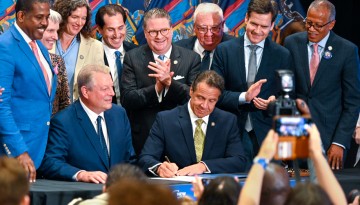
Cornell professor Bob Howarth played a key role – reckoning methane as a carbon dioxide equivalent – in New York’s Climate Leadership and Communities Protection Act.
Cornell and the Atkinson Center helped organize a workshop, “Helping NYS address its climate goals through thermochemical conversion,” on July 16 to develop opportunities for New York to meet its climate goals.
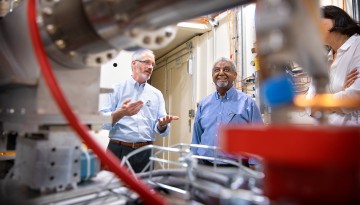
The Cornell High Energy Synchrotron Source, or CHESS, has been awarded $54 million from the National Science Foundation for a new subfacility, the Center for High-Energy X-ray Sciences at CHESS.
Cornell researchers have released a free, open-source software to help make potentially subjective and time-consuming plant breeding decisions more consistent and efficient.
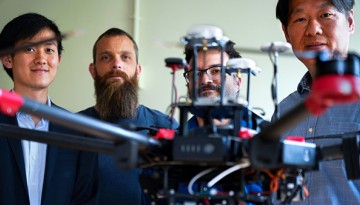
The new Shen Fund for Social Impact will enable students to pursue engineering projects that could benefit society by using technology in innovative ways.
Africana studies professor Grant Farred muses on soccer, separation, relation and belonging in his new book, “Entre Nous: Between the World Cup and Me.”
Having healthy gut flora – the trillions of bacteria housed in our intestines – could lower the risk of infection following knee and hip replacement surgeries, while an unhealthy intestinal flora may increase the risk of infection.
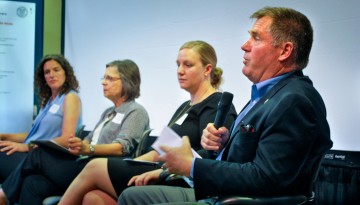
Cornell hosted a two-day workshop in late June addressing criticisms of contemporary macroeconomics, organized by professor Kieran Donaghy with support from the Atkinson Center for a Sustainable Future.
In a study designed to measure perceptions of inequality, Cornell researchers found that winners of a simple card game were far more likely than losers to believe the game’s outcome was fair, even when it was heavily tilted in their favor.