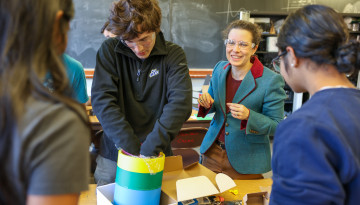
Cornell Engineering is rapidly becoming a leader in engineering education research, a field dedicated to designing effective education systems and learning experiences for students. The insights emerging from this work have the potential to redefine engineering education on campus and far outside it.
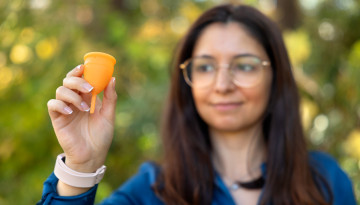
To equip astronauts with health choices for future missions, a Cornell postdoctoral fellow is leading research with AstroCup, a group that recently tested two menstrual cups in spaceflight as payload on an uncrewed rocket flight.
CTI's 2024-2025 Innovative Teaching & Learning grant recipients focused on how students' thoughts are shaped and expanded upon through the agency of storytelling and the power of metacognitive assessment.
An interdisciplinary team of researchers determined that organic residues of plant oils are poorly preserved in calcareous soils from the Mediterranean, leading decades of archaeologists to likely misidentify olive oil in ceramic artifacts.
REEgen, a Cornell spinout focused on rare earth element (REE) recovery, won the $150,000 grand prize at the 2025 FuzeHub Commercialization Competition, held at the New York State Innovation Summit on Oct. 29-30.
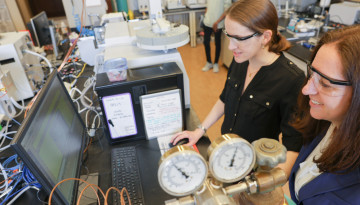
By studying the theoretical limits of how light can be used to perform computation, Cornell researchers have uncovered new insights and strategies for designing energy-efficient optical computing systems.
Researchers are using 3D printing to custom build high-efficiency, low-cost electric rockets that, combined with novel propellants, will keep small satellites in low Earth orbit.