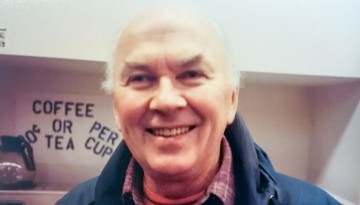
A team of chemists, including Cornell’s Paul Houston, has unveiled the mechanics involved in the interplay between sunlight and molecules known as “roaming reactions,” which could improve climate change modeling.
Cornell has secured a U.S. Department of Energy grant, expected to total about $7.2 million, which will fund exploratory research to help verify the feasibility of using a novel geothermal energy system to heat its campus buildings.
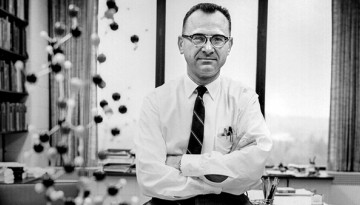
Harold A. Scheraga, the George W. and Grace L. Todd Professor Emeritus of Chemistry in the College of Arts and Sciences, who had a profound impact shaping the understanding of protein structure, died Aug. 1 in Ithaca. He was 98.
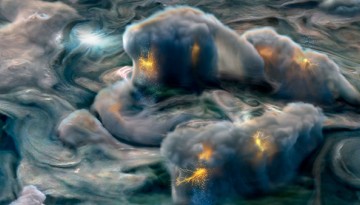
NASA’s Juno spacecraft – closely observing Jupiter – has unexpectedly discovered lightning in the planet’s upper atmosphere, according to a NASA/JPL study, which includes two Cornell researchers.
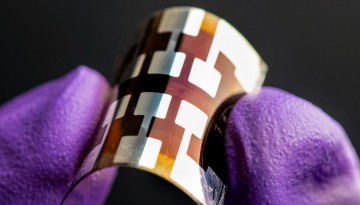
When it comes to the future of solar energy cells, say farewell to silicon, and hello to calcium titanium oxide – the compound mineral better known as perovskite.
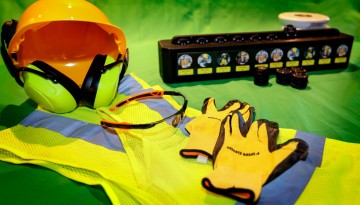
A Cornell-based startup has shifted its platform’s technology in response to the pandemic, ensuring social distancing in the workplace and enabling companies to bring employees back to work safely.
A $5 million gift from David A. Duffield ’62, MBA ’64, has established the Duffield Family Cornell Promise Scholarship, providing financial assistance to undergraduate engineering students in response to the COVID-19 pandemic.
In Nature Geoscience, Cornell’s Johannes Lehmann says that scientists should develop new models that accurately reflect soil carbon-storage processes to draw down atmospheric carbon dioxide.