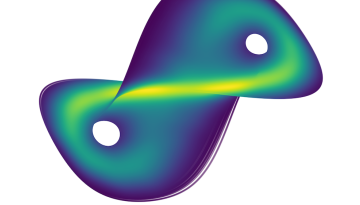
Using time-delay snapshots, researchers led by mathematician Yunan Yang have introduced a new way to identify the underlying dynamics of unpredictable systems, such as the atmosphere and turbulent fluids.
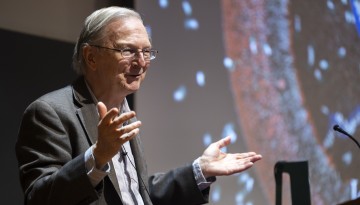
Nobel Laureate Jack Szostak, Ph.D. ’77, shared decades of research into one of biology’s most puzzling mysteries to a crowded room Oct. 9 during the 2025 Ef Racker Lecture.
Cornell physicist Brad Ramshaw has been named a 2025 Experimental Physics Investigator – national recognition awarded by the Gordon and Betty Moore Foundation to a select group of researchers pushing the boundaries of experimental physics.
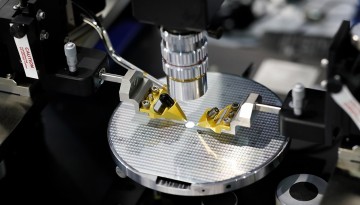
Cornell researchers have built a programmable optical chip that can change the color of light by merging photons, without requiring a new chip for new colors – technology that could potentially be used for classical and quantum communications networks.
A Cornell doctoral student has developed an open-source software package that could transform how engineers design floating offshore structures for renewable energy and other ocean applications.
The Center for Teaching Innovation published two series of adaptable case studies, from the Creative Teaching Awards and Provost’s Working Group for Innovation in Assessment, showcasing new Cornell faculty approaches to assessing student learning.