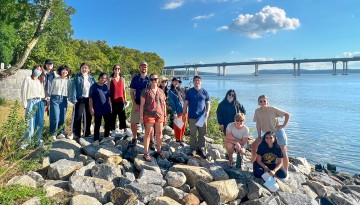
As sea levels rise over the next decades for low-lying Hudson River towns, Cornell landscape architecture students offered ideas for coping with climate change and embracing the water.
Cornell researchers discovered that colors can help quantify the way energy moves through a specific type of crystal, in which light-sensitive molecules are arranged.
Karen Vogtmann is among 120 members and 30 international members who were elected in 2022, in recognition of their distinguished and continuing achievements in original research.
Assistant professor Amal El-Ghazaly received an NSF CAREER Award for research that could ultimately make next-generation wireless systems more accessible worldwide.
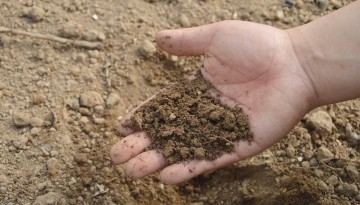
Assistant professor Matthew Reid received an NSF CAREER Award to research how carbon can be transformed in the environment to create fuel for nitrogen-consuming bacteria, ultimately reducing nutrient pollution.
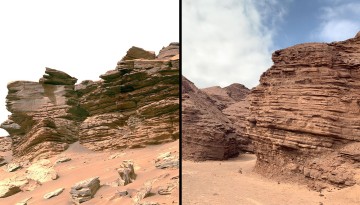
Current instrumentation being sent to Mars to collect and analyze evidence of ancient life on the red planet might not be sensitive enough to make accurate assessments, according to an international research team co-led by a Cornell astronomer.
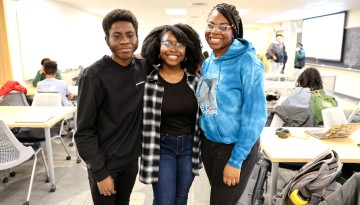
The Cornell chapter of the National Society of Black Engineers is celebrating Black History Month with a variety of events expected to be well attended thanks to the student organization’s recent efforts to boost membership and revitalize its programming.
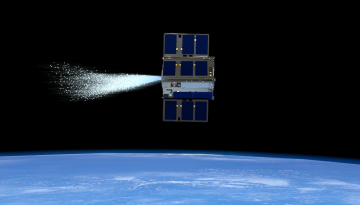
Engineering professor Elaine Petro received an Air Force Office of Scientific Research Young Investigator Program Award to research spacecraft propellants.
First-of-their-kind observations reveal new details about melting at the grounding line of the vulnerable Thwaites Glacier that is contributing to its retreat and potentially to sea-level rise, according to Cornell researchers and international collaborators.