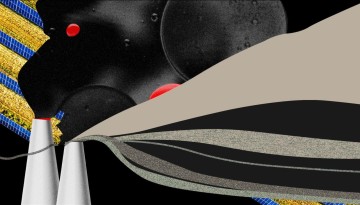
As the need to find climate change solutions becomes ever more urgent, Cornell chemists are leading the way with innovative and far-reaching discoveries, including better electric batteries, carbon capture technologies, renewable plastics and improvements in solar cells.
Phenomena common to Earth’s atmosphere can appear in the skies over some exoplanets of the “hot Jupiter” variety, a common type of gaseous giant that always orbits close to its host star, according to new research.
Project teams in Rev: Ithaca's Prototyping Hardware Accelerator will present their ideas – from AI cocktail generators to plastic recycling machines - at Demo Day on July 31.
The NSF, in partnership with Intel, will invest $20 million over five years to establish the Artificial Intelligence Materials Institute at Cornell, as part of the National Artificial Intelligence Research Institutes.
Cornell researchers have uncovered a microscopic layer of carbon contamination, often left behind by air exposure and fabrication techniques, that impairs electrical flow in devices made with gallium oxide. They also found a solution.
Using custom-built computer simulations, Cornell researchers have visualized solid-solid phase transitions in unprecedented detail, capturing the motion of every particle in a theoretical material as its crystal structure morphs into another.
A Cornell Engineering team was on the cusp of significant progress developing an advanced laser useful for military and civilian applications, but a stop-work order prevented final experiments from proceeding.
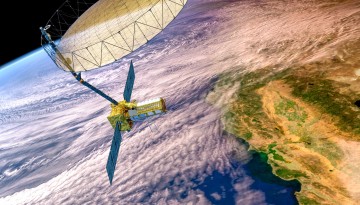
NASA and the Indian Space Research Organization are launching a satellite that uses synthetic aperture radar – and Cornell expertise – to monitor nearly all the planet’s land- and ice-covered surfaces twice every 12 days.