Sarah Dean, assistant professor of computer science, led 45 high school students attending a Cornell Engineering outreach program in the launch of two WindBorne weather balloons to collect data from the atmosphere for weather prediction.
News directly from Cornell's colleges and centers
Students learn about AI, engineering through weather balloons
By Patricia Waldron
It was a beautiful sunny day on July 15, when 45 high school students gathered on Jessup field to launch a weather balloon that would collect atmospheric data as it flew through the sky.
Sarah Dean, assistant professor of computer science in the Cornell Ann S. Bowers College of Computing and Information Science, organized the launch as part of a week-long outreach program run by the Office of Inclusive Excellence at Cornell Engineering. The program gives high school students interested in STEM careers an in-depth learning experience in a college environment and exposure to the wide breadth of engineering fields available. Students traveled from all over to attend, with about 20% coming from New York state.
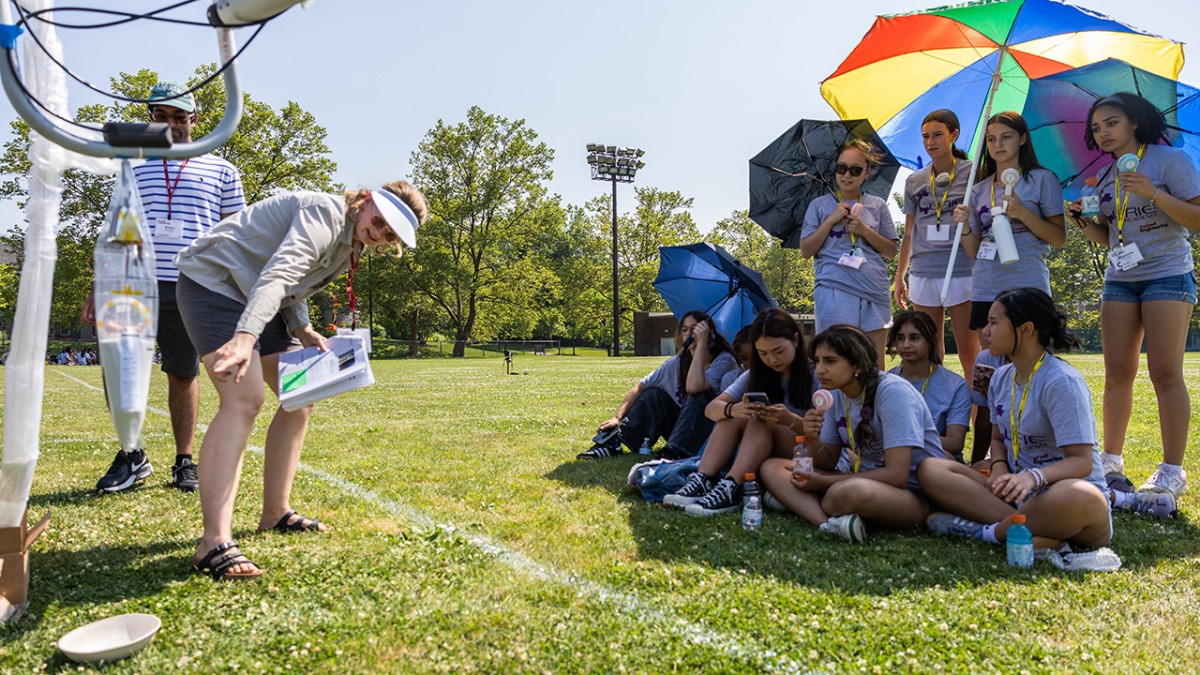
Sarah Dean readies a weather balloon for launch with high school students from a Cornell Engineering Office of Inclusive Excellence outreach program. Credit: Bridget Fesko
“There's no engineering classes at my school, but I really like math and science,” said Sarah O’Donnell, a rising high school junior from Scranton, Pennsylvania. “That's why I personally like this program, because you get to see the different engineering fields, and I feel like that will maybe help me discern more about what I want to do.”
The weather for the launch was perfect – maybe too perfect – with clear skies and temperatures rising to almost 90 degrees in the open field. Students stood underneath umbrellas to stay out of the sun.
WindBorne Systems, a start up based in Palo Alto focused on building a planetary constellation of their Global Sounding Balloons, donated two of their balloons to the program. The company launches hundreds of their long-lasting weather balloons each week and uses the collected atmospheric data to generate accurate weather forecasts through AI-based prediction models. The balloons also leverage advanced AI models to analyze conditions and make navigation decisions based on the results.
Read the entire story on the Cornell Bowers website.
Media Contact
Get Cornell news delivered right to your inbox.
Subscribe
