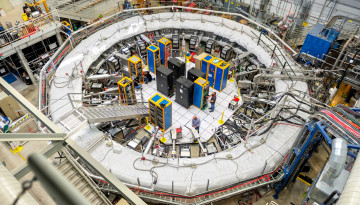
Lawrence Gibbons, professor of physics in the College of Arts and Sciences, is among the researchers awarded the prestigious physics prize for his muon g-2 collaborations.
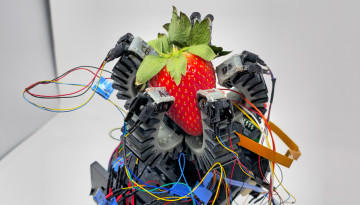
Cornell researchers used stretchable fiber-optic sensors to create a soft robot gripper that can predict the ripeness of strawberries by touch, then pick them without causing any damage.
Jonathan Butcher, the Joseph N. Pew Jr. Professor in Engineering in the Meinig School of Biomedical Engineering, has been named this year’s recipient of the Kaplan Family Distinguished Faculty Fellowship from the Einhorn Center.
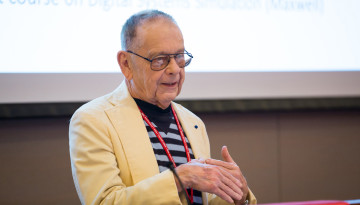
William L. Maxwell ’57, Ph.D. ’61, the Andrew Schultz Jr. Professor Emeritus of Industrial Engineering and a pioneer in the field of simulation and scheduling, died March 31 in Indiana, Pennsylvania. He was 91.
A team of geophysicists from Cornell, Cameroon and South Africa is using machine learning tools to unearth new information from earthquake data collected by Cornell 15 years ago – providing a lifeline for a scholar whose career was upended by conflict.
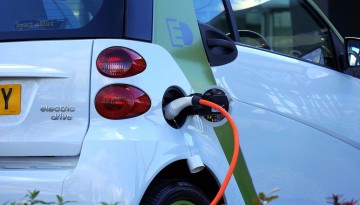
A new study finds that the global shift to electric vehicles could significantly reduce energy use and carbon emissions, but only if governments act aggressively to lower costs and align policies across regions.