Using a laser technology he developed at Cornell, physics professor Chris Xu and collaborators report sharp imaging of a subcortical region of the brain, using novel three-photon microscopy.
On Feb. 16, a standing-room-only crowd in Myron Taylor Hall was granted a glimpse of North Korean life when defector "Mr. Kim" told about his life and escape to the United States.
Ten students from across Cornell spent two weeks of their winter break on a journey through Vietnam, listening to farmers and community members and seeing the effects of climate change firsthand.
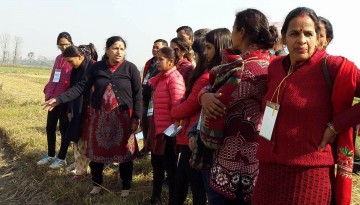
More than 200 farmers, representatives from Cornell's Delivering Genetic Gain in Wheat project and the Nepal government gathered for the inauguration of the Seed Systems for Nepal initiative Jan. 23.
In a "Chats in the Stacks" at Olin Library on Feb. 15, German studies professor Patrizia McBride discussed her latest book, "The Chatter of the Visible."
To help Fijian scientists track oceanic climate change for their islands in the sun, Cornell's Bruce Monger unveils eyes in the sky: satellite remote sensing.
Students and faculty gathered to discuss immigration policy Feb. 15, particularly the travel ban prohibiting people from seven Muslim-majority countries from coming to the United States for 90 days.
Salmonella food poisoning wallops you for several days, but new research by Cornell food scientists indicates that some of its serotypes – variations of the bacterial species – can have permanent repercussions. It may damage your DNA.