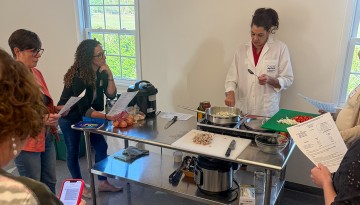
A new Cornell-led training program aims to provide New York food educators and producers with the skills and equipment they need to boost compliance with modern food safety standards and foster the development of innovative food products.
Cornell Law School welcomed alumnus Michael Toner ’92, partner at Wiley Rein in Washington, D.C., and former chairman of the Federal Election Commission, for a wide-ranging fireside chat.
$3 billion in recent private investments in dairy manufacturing have supercharged the need for companies to find new workers. Cornell is helping with extension trainings and bootcamps.
A new documentary chronicling the life and scientific legacy of Nobel Laureate Phil Sharp will be screened at Cornell Cinema on Monday, Oct. 27, at 6 p.m. in Willard Straight Hall. Sponsored by the Cornell Institute of Biotechnology, the showing is free and open to the public.
The unrestricted fellowship funds enables Oliva and the 19 other fellows named this year to “test novel ideas and lead research that drives real-world impact.”
Registration is now open for the 2026 Cornell University Winter Session online. Classes run January 2–17, 2026.Students can take classes in subjects such as accounting, biology, business, design, economics, entomology, film, history, plant science, psychology, statistics, and more.
Nobel Laureate Jack Szostak, Ph.D. ’77, shared decades of research into one of biology’s most puzzling mysteries to a crowded room Oct. 9 during the 2025 Ef Racker Lecture.
More than a century after pioneering engineer Marie Reith vowed to “do some good” in the world, her legacy endures through the new Marie Reith Class of 1921 Scholarship. Funded by Herb Fontecilla ’66, M.Eng. ’67, the gift honors the woman who helped him begin his Cornell journey and will support future first-generation engineers.
The artificial intelligence models underlying popular chatbots and content moderation systems struggle to identify offensive, ableist social media posts in English – and perform even worse in Hindi, new Cornell research finds.
Scientists at the Cornell College of Veterinary Medicine have found that administering a rotavirus vaccine to newborn mice via a shot, rather than an oral dose, increases its efficacy, particularly for at-risk newborns.