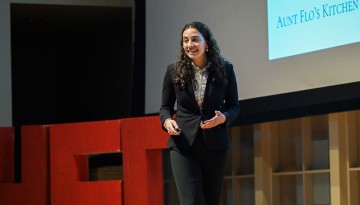
Students shared their innovative projects at the Cornell Fashion & Design Expo, the annual juried exhibition hosted by the Department of Human Centered Design (HCD).
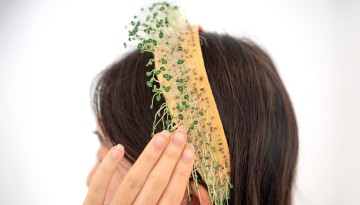
Researchers in the College of Human Ecology have developed a design and fabrication approach that treats plants as companions to humans, with seeds woven into hydrogel material for apparel and other applications.
Cornell Tech leadership, alongside elected officials, faculty, students, staff, and the Roosevelt Island community, hosted an official ribbon-cutting ceremony to celebrate the opening of the campus’s new MakerLAB on May 2.
The American Society for Nutrition Foundation and the Novo Nordisk Foundation recognized Julia Finkelstein, associate professor in Nutritional Sciences, for her work on in vitamin B12 and one-carbon metabolism.
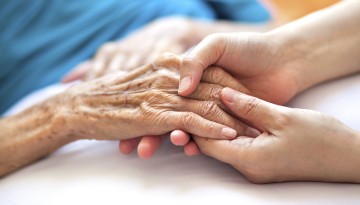
Home care cooperatives may be the key to alleviating the shortage of paid caregivers for older Americans, according to a new study co-authored by Senior Associate Dean for Outreach and Sponsored Research Ariel Avgar, Ph.D. ’08, and Dr. Madeline Sterling, A&S ’08, associate professor of medicine at Weill Cornell Medicine and director of ILR’s Initiative on Home Care Work.
Cornell researchers found that by prioritizing the perspectives of white Americans instead of those from underrepresented groups, studies of pandemic disparities likely missed important insights from those most affected by COVID-19.
Matthew Velasco, assistant professor of anthropology in the College of Arts and Sciences, and Anna Whittemore, doctoral candidate in anthropology, received awards from the Society for American Archaeology (SAA) at the SAA annual meeting on April 25.
A ceremonial ribbon-cutting on May 1 formally welcomed the Feil Family and Weill Family Residence Hall, located at the northwest corner of 74th Street and York Avenue, into Weill Cornell Medicine’s main campus.
A team of researchers at Cornell University have made a discovery in fruit flies that could change the way we understand brain diseases like Alzheimer’s and Parkinson’s in humans.