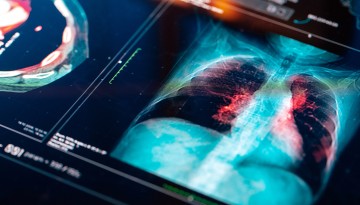
Surgery that removes only a portion of one of the five lobes that comprise a lung is as effective as the traditional surgery that removes an entire lobe for certain patients with early-stage lung cancer, a new study has found.
Since joining the NFL Players Association as its general counsel in 2010, Sean Sansiveri ’05 has been behind the NFL’s most important measures to make the game safer – including the protocol that helped save Buffalo safety Damar Hamlin’s life.
Understanding the physics behind this mysterious phase transition could lead to new complex microscopic circuits, superconductors and exotic insulators that could find use in quantum computing.
Dyson professor Suzanne Shu and colleagues found that considering one’s “future self” played a key role in how people decide when to start collecting monthly Social Security benefits. Societal norms regarding retirement, however, do not.
Cornell scientists have unearthed precise, microscopic clues to where magma is stored in Earth’s mantle, offering scientists – and government officials – a way to gauge volcanic eruption risk.
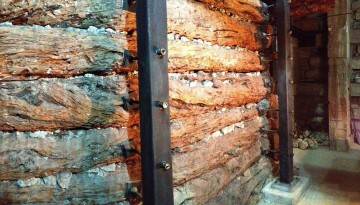
An interdisciplinary collaboration used tree ring and isotope records to pinpoint a likely culprit for the collapse of the Hittite Empire: three straight years of severe drought in an already dry period.
In her new book, “Unknowing and the Everyday: Sufism and Knowledge in Iran,” Seema Golestaneh explores the ways the Sufi mystical experience – particularly the role of mystical knowledge – is shaping contemporary life in Iran.
An investigation at Tirez lagoon in central Spain, analogous to the surface of Mars, concludes that if life existed when the planet had liquid water on its surface, desiccation would not have necessarily implied that life disappeared for good.
A synthetic biosensor that mimics properties found in cell membranes and provides an electronic readout of activity could lead to development of new drugs and the creation of sensory organs on a chip.
Johnson associate professor Ori Heffetz and a colleague conducted experiments in three countries to gauge the public’s perception of relative risk factors of different public health behaviors amid the COVID-19 pandemic.
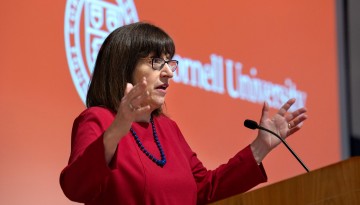
Praising Cornell’s employees for the key role they play in the university’s success, President Martha E. Pollack announced bonuses for eligible staff members as she kicked off her annual Address to Staff, held Feb 6.