Julie Hulali Morikawa ’01 founded ClimbHI to help Hawai‘i middle and high school students explore career options, uncover what they really enjoy doing, and get a better sense of the practical steps necessary to pursue their goals.
The pathogen listeria soon may become easier to track down in food recalls, thanks to a new genomic and geological mapping tool created by Cornell food scientists.
At Cornell, the Community Learning and Service Partnership (CLASP) program is breaking the mold by forming mutual learning opportunities between students and employees, providing an innovative approach to lifelong learning, mentoring and cross-cultural communication right on campus.
According to new research co-led by Jonathon Schuldt ’04, associate professor of communication, family values are a much stronger predictor of climate opinions and policy support than political views for U.S. Latinos.
Thanks to Cornell researchers and their colleagues, a dataset of thousands of experiments is publicly available, providing insight into fields like political science, communication, psychology, marketing, organizational behavior, statistics, computer science and education.
The Royal Liverpool Philharmonic Orchestra will launch its 2021-22 season on Oct. 14 with the world premiere of “Symphony No. 6,” composed by Roberto Sierra, the Old Dominion Foundation Professor in the Humanities in the College of Arts and Sciences.
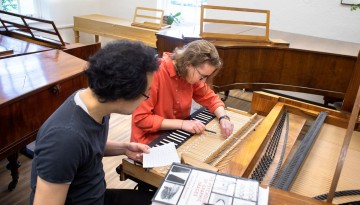
An undergraduate, Elizaveta Zabelina ’24, is teaming up with a music department faculty member to create an illustrated catalog and guide to the instruments that are part of Cornell's historical keyboard collection.
In a new book, “Policymaker’s Journal,” Kaushik Basu offers musings about economic policymaking and public life during his years serving as chief economic adviser in India’s finance ministry and chief economist at the World Bank.
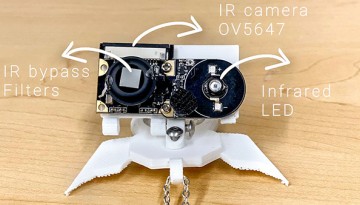
Tracking facial movements, and possibly their cause, is one of the proposed applications for NeckFace, a necklace-type wearable sensing technology developed in the lab of Cheng Zhang, assistant professor of information science.
Max Pfeffer, a distinguished researcher of rural and urban communities and a leader who helped reshape the College of Agriculture and Life Sciences for the 21st century, is now emeritus professor of global development.