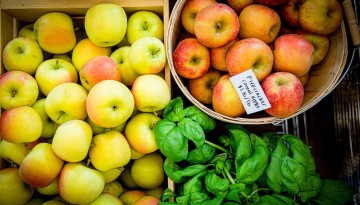
Food systems make up roughly 30% of total greenhouse gas emissions globally. But transforming them could cut these emissions by more than half, according to a report released Oct. 3 from a commission of global experts.
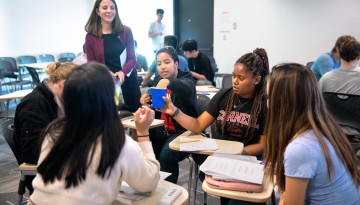
The team found a significant uptick in the number of articles published after 2013 that focused on core concepts and competencies suggested in a seminal report.
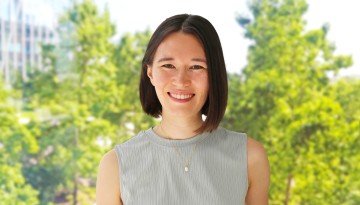
Artificial intelligence is everywhere, from the apps people use to the systems that shape hiring decisions and healthcare. But what happens when these tools don’t work equally well for everyone? That question drives the research of Allison Koenecke, a new assistant professor of information science at Cornell Tech.
Liberals and conservatives both oppose censorship of children’s literature – unless the writing offends their own political ideology, showing how a once-bipartisan issue has become polarized.
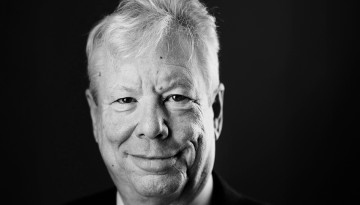
Nobel Prize-winning economist and former Cornell Professor Richard Thaler will visit campus Oct. 17 for a conversation about his groundbreaking work in the field of behavioral economics.
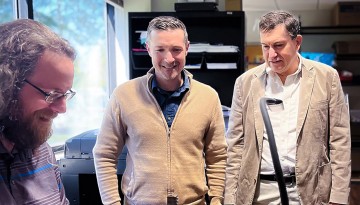
Investigators at Weill Cornell Medicine and Cornell’s Ithaca campus will use a $5.1 million grant from the NIH to launch the Autism Replication, Validation, and Reproducibility Center, which aims to improve the reliability of autism research.
Since its opening in November 1945, the Cornell University School of Industrial and Labor Relations has had an outsized impact on unions, corporations, governments and non-profit organizations in New York state and around the world.
The Action Research Collaborative, housed in the Bronfenbrenner Center for Translational Research, is partnering with a New York state agency to strengthen early childhood care and education across the state.