Avner Arbel, an influential thought leader and scholar in hospitality research and education and an emeritus professor of financial management in the Cornell Peter and Stephanie Nolan School of Hotel Administration, died Aug. 22 in Jupiter, Florida. He was 90.
Students who plan to use ChatGPT to write their college admissions essays should think twice: Artificial intelligence tools write highly generic personal narratives, even when prompted to write from the perspective of someone with a certain race or gender.
Cornell alumnus Lawrence M. Wein, a Stanford professor and leading operations researcher, will return to campus Oct. 7 to present his new algorithm for accelerating forensic genealogy, capable of identifying suspects up to 25 times faster than standard methods.
The role social justice advocacy should play in medicine will be examined by Sally Satel, a practicing psychiatrist and lecturer at Yale University School of Medicine, in her talk, “Medicine in the Age of Social Justice Activism.”
A specialist in literary and cultural theory and French literature of the 19th century, Culler will receive the award in June 2026 during the International Society for the Study of Narrative conference in Denmark.
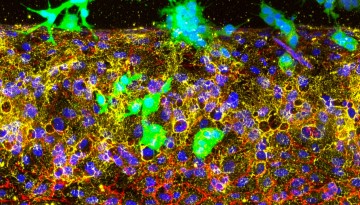
Increased risk for anxiety may begin before birth, shaped by infection or stressful events during pregnancy, according to a new study from researchers at Weill Cornell Medicine.
Cornell will commemorate the 100th anniversary of Willard Straight Hall – one of the country’s first student unions – with a yearlong series of events honoring its legacy as a hub of student life and community.
Claudia Fischbach-Teschl, director of the Meinig School of Biomedical Engineering, was appointed leader of Engineering Innovations in Medicine, an initiative to transform human health through data-driven innovation and interdisciplinary collaboration.
Failing to express expected levels of emotion and urgency may trigger suspicion that 911 callers are participants in the crime they are reporting – potentially the first step toward a wrongful conviction.
A new study revealed how a deadly form of pancreatic cancer enters the bloodstream, solving a long-standing mystery of how the disease spreads and identifying a promising target for therapy.