A ceremonial ribbon-cutting on May 1 formally welcomed the Feil Family and Weill Family Residence Hall, located at the northwest corner of 74th Street and York Avenue, into Weill Cornell Medicine’s main campus.
A team of researchers at Cornell University have made a discovery in fruit flies that could change the way we understand brain diseases like Alzheimer’s and Parkinson’s in humans.
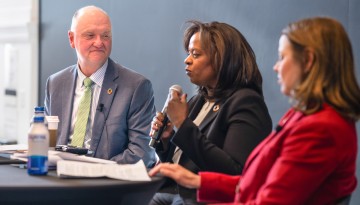
The evolving role of ethics in business leadership, and how leaders can balance navigating climate change and inequality with turning a profit, were key themes at this year’s David J. BenDaniel Lecture in Business Ethics.
Teams of health care providers called Accountable Care Organizations participating in the Medicare Shared Savings Program have saved Medicare between $4.1 billion and $8.1 billion from 2012–2019, according to a new study from Weill Cornell Medicine investigators.
“Politics, Markets, and Governance in Africa: A conference in honor of Nicolas van de Walle,” set for May 8-9, will focus on the core themes of African political economy, regimes, and modes of electoral and social participation and contestation.
In the Hospitality Digital Marketing certificate program, Cornell Nolan School faculty share principles for integrating corporate brand communications across media channels.
Award-winning poet Ishion Hutchinson is making his prose debut with his first essay collection, which brings together two decades’ worth of probing reflections on his childhood in Jamaica, the country’s cultural and colonial history and his maturation as a writer.
The rating system is the first of its kind and may help urban planners and robotics companies plan for future robot deployments that won’t disrupt existing sidewalk environments.