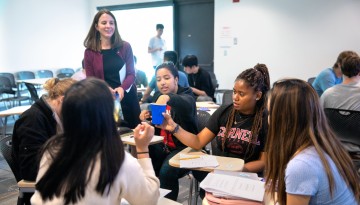
Engaging with a whole set of mentors will allow the CIDER postdocs to approach questions about student learning and experiences across disciplinary boundaries and use techniques from multiple fields.
Researchers studying artificial intelligence training data and treatment of swelling linked to breast cancer are among the eight Cornell assistant professors who recently received National Science Foundation Faculty Early Career Development Awards.
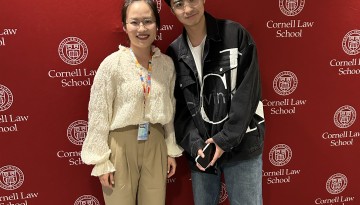
On Aug. 19, Cornell Law School welcomed 216 talented, diverse students of the J.D. Class of 2027 to their first day of Orientation. The event began an exciting journey for these students, who hail from seven countries, 34 states and the District of Columbia.
Cornell researchers discovered a new way of controlling biohybrid robots that can react to their environment better than their purely synthetic counterparts: harnessing fungal mycelia’s innate electrical signals.
Study opens the door to exploring new targets for therapies for fibrolamellar carcinoma, which does not respond to conventional treatments and leaves patients with approximately a year to live on average once it is detected.
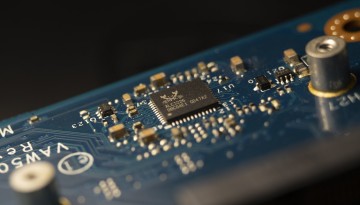
Cornell researchers, collaborating with the Florida-based technology company Lit Thinking, are working to overcome some of aluminum nitride's key limitations as a next-generation semiconductor material using a new grant.
Researchers found that cooperative partnerships seeking to spread the cost burden of water infrastructure projects often end up forcing local partners to bear the brunt of supply and financial risks.
Items from the Cornell Fashion and Textile Collection make up over 75% of the exhibit “Influencers: 1920s fashion and the New Woman” at Lyndhurst Mansion in Tarrytown, New York.
What are the options for limiting harm as AI use grows? This is one of the questions a network of international colleagues are tackling in a research collaboration launched with a 2022 Joint Research Seed Grant from Global Cornell’s Global Hubs initiative. This year’s cycle of Global Hubs seed grants recently opened.
The upcoming International Fair is poised to spark students’ interest in the world on Wednesday, Aug. 28, from 11 a.m to 1:30 p.m. on the Uris Hall Terrace.
Cornell researchers have demonstrated that acoustic sound waves can be used to control the motion of an electron as it orbits a lattice defect in a diamond, a technique that can potentially improve the sensitivity of quantum sensors and be used in other quantum devices.
On August 8, Cornell Law School welcomed 129 accomplished and enthusiastic students from around the world to Orientation for their one-year Master of Laws (LL.M.) graduate program.