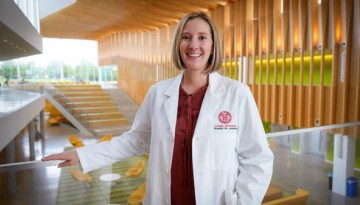
Dr. Erin Scott is an associate professor of ophthalmology in the Department of Clinical Sciences, and the second faculty member supported by the Cornell Margaret and Richard Riney Canine Health Center.
The Adam and Rachel Broder Fund for Cancer Research, which provides seed funding for scientists, is available to any Cornell faculty member. They are administered by the College of Veterinary Medicine, which has a long history of translational cancer research.
Spilling out beyond gallery walls and across campus, the 2022 Cornell Biennial "Futurities, Uncertain" is well underway and features work by AAP faculty, students, alumni, and guests.
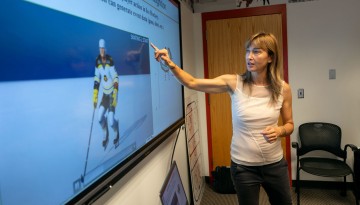
The algorithms are unique in that they take a holistic approach to action anticipation, combining visual data – where an athlete is located on the court – with information like an athlete’s specific role on the team.
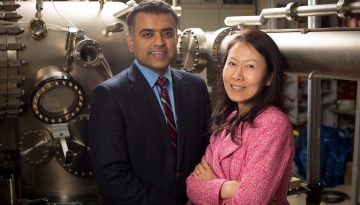
A group of researchers led by Cornell is unlocking the full potential of aluminum nitride – an important material for the advancement of electronics and photonics – thanks to the development of a surface cleaning technique that enables high-quality production.
In an adaptation to climate change, tree swallows have become smaller over the last three decades, an ongoing study based in Tompkins County has found.
A mummified bird – and the research into its historical context and extraordinary afterlife – will be on display in an exhibition that runs Oct. 7-9, from 9 a.m. to 7 p.m., in Upson Hall’s Lounge 116.
An advanced software tool for analyzing DNA sequences from tumor samples has uncovered likely new cancer-driving genes, in a study led by Weill Cornell Medicine researchers.
A new perspective piece from the College of Veterinary Medicine highlights the vital relationship between wildlife health and the North American Model of Wildlife Conservation.