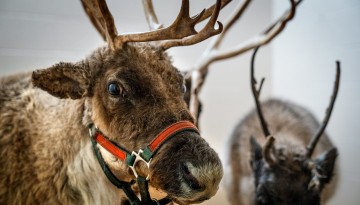
A reindeer mother and daughter are ready for duty this holiday season following cataract surgery in late summer at the Cornell University Equine and Nemo Farm Animal Hospital.
Orbiting 250 miles above the Earth on the International Space Station, astronaut and station commander Luca Parmitano on Dec. 10-11 conducted a Cornell-designed experiment that will help validate numerical models used for a number of industrial and geophysical applications.
Staff and student participants in the Community Learning and Service Partnership program attended a Dec. 12 luncheon in Warren Hall for a “midyear celebration of learning.”
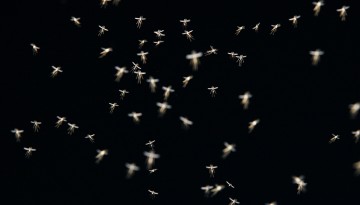
Four Cornell researchers took a deeper look at mosquito reproduction with the goal of helping humans combat outbreaks of diseases such as dengue and Zika, which are worsening as the climate warms.
Cornell researchers developed a first-of-its-kind model to control traffic and intersections in order to increase autonomous car capacity on urban streets, reduce congestion and minimize accidents.
Staff, university leaders, industry partners and government representatives attended a Dec. 5 celebration of the launch of the Cornell-Brookhaven ERL Test Accelerator facility, known as CBETA.
Events at Cornell this week and through the winter break include student film screenings, winter solstice celebrations, the Cornell Concerto Competition and Winter Employee Celebration.
The Northeast ADA Center, in the ILR School’s Yang-Tan Institute, is partnering with Planned Parenthood of the Southern Finger Lakes to help the organization create a more inclusive environment for its patients.
More than 100 engineering students let off some end-of-semester steam and tried not to blow any gaskets at the annual Robotics Day competition, held Dec. 10 in Duffield Hall atrium.
Sweet meets heat in “We Cayenne Change the World,” a rich, velvety chocolate ice cream, with a burst of cayenne pepper. Get an extra scoop, as it won Cornell’s annual Food Science 1101 final project.
William E. “Bill” Macaulay, longtime benefactor of the Cornell Lab of Ornithology and passionate supporter of higher education, died Nov. 26 at the age of 74.
Six custodial and housekeeping workers were honored with Bartels Awards for Custodial Service Excellence at an annual ceremony, held Dec. 10 in Bartels Hall.