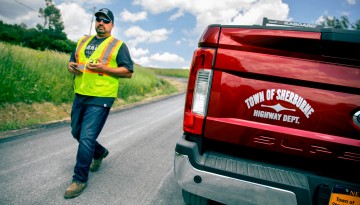
The Cornell Local Roads Program improves New York’s roads by serving the 1,500 village, town and county officials who maintain them, with workshops, technical assistance and up-to-date best practices.
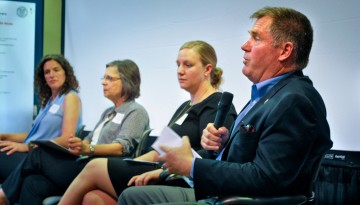
A new study co-authored by Kelly Zamudio, professor of ecology and evolutionary biology, shows that increasing class size has the largest negative impact on female participation in STEM classrooms.
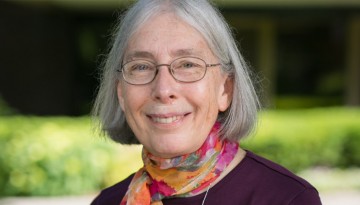
Martha P. Haynes, the Goldwin Smith Professor of Astronomy, has received the 2019 Catherine Wolfe Bruce Gold Medal for career achievement, from the Astronomical Society of the Pacific.
An artificial intelligence system developed by a Cornell-led team has identified a promising material for creating more efficient fuel cells – a potential breakthrough in both materials science and machine learning.
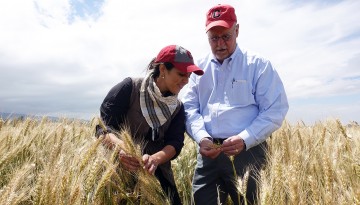
Ronnie Coffman, director of International Programs in the College of Agriculture and Life Sciences, addressed the International Wheat Congress July 23 in Canada, urging renewed commitment to germplasm exchange.
Cornell professor Bob Howarth played a key role – reckoning methane as a carbon dioxide equivalent – in New York’s Climate Leadership and Communities Protection Act.
Cornell and the Atkinson Center helped organize a workshop, “Helping NYS address its climate goals through thermochemical conversion,” on July 16 to develop opportunities for New York to meet its climate goals.
The Cornell High Energy Synchrotron Source, or CHESS, has been awarded $54 million from the National Science Foundation for a new subfacility, the Center for High-Energy X-ray Sciences at CHESS.
Cornell researchers have released a free, open-source software to help make potentially subjective and time-consuming plant breeding decisions more consistent and efficient.
The new Shen Fund for Social Impact will enable students to pursue engineering projects that could benefit society by using technology in innovative ways.
Africana studies professor Grant Farred muses on soccer, separation, relation and belonging in his new book, “Entre Nous: Between the World Cup and Me.”
Having healthy gut flora – the trillions of bacteria housed in our intestines – could lower the risk of infection following knee and hip replacement surgeries, while an unhealthy intestinal flora may increase the risk of infection.