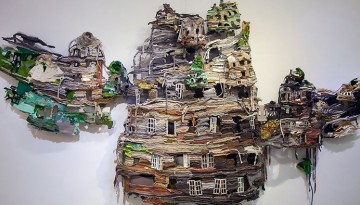
Creators of an exhibit will photographs and stories of residents of La Gloria, a Guatemalan refugee community of 3,800 people in Chiapas, Mexico, speak Nov. 9 in Rockefeller Hall.
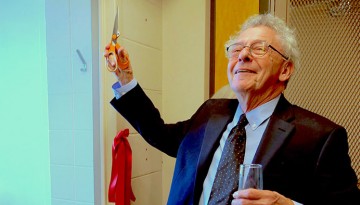
A new space in Olin Library has been dedicated as the Isaac Kramnick Faculty Research Study in honor of the Richard J. Schwartz Professor of Government Emeritus.
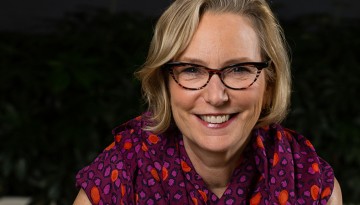
Sandra E. Peterson ’80 will speak on “Reconstructing Leadership: Why Economics and Empathy Matter in Equal Measure”, Nov. 1 at 4:30 p.m. in Alice Statler Auditorium.
A group of Cornell researchers has received a $1 million grant from the U.S. Agency for International Development to use machine learning to rapidly analyze agricultural and food market conditions, aiming to better predict poverty and undernutrition in some of the world’s poorest regions.
With a a three-year, $450,000 Young Investigator Award from the Air Force Office of Scientific Research, Francesco Monticone will develop and study exotic materials.
For her work on solar-powered irrigation with Nepalese women, Cornell freshman Isabella Culotta received the 2018 Elaine Szymoniak Award at the 2018 World Food Prize Laureate Award Ceremony in Des Moines, Iowa.
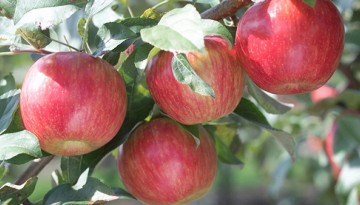
The Cornell Orchards Store, at 709 Dryden Road, Ithaca, is holding its inaugural Apple Bake-off Nov. 3, open to the public, to benefit the United Way of Tompkins County.
Success did not come easy to Sonia Sotomayor. She knows how much pain there is in life. But hard work, a determination to fight for her beliefs and an “innate optimism” helped propel her from a childhood in a Bronx housing project to her role as associate justice of the U.S. Supreme Court.
Events this week include music for experimental instruments, whales and chimes; architect and A.D. White professor Brinda Somaya; artist and fashion designer Ruby Chishti; and author Viet Thanh Nguyen.
Employees are asked to share their sense of belonging and connectedness at Cornell through a series of informal “Staff Conversations” being held this fall.