New event asks the community to decrease technology use, increase face-to-face interaction and consider that every AI chat, doomscroll and text message has a water, energy and carbon footprint.
Cornell and global leaders will come together at Climate Week NYC Sept. 20-27 to discuss some of the world’s most pressing sustainability challenges, including harnessing AI’s power while mitigating its negative impacts.
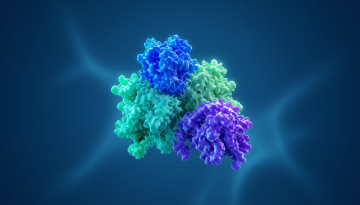
Cornell researchers have used artificial intelligence to uncover a previously unknown way cells control how proteins move inside them, a process essential for growth, communication and movement, and one that is often disrupted in cancer.
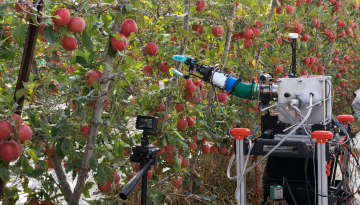
A Cornell-led research project is developing robots that can perform labor-intensive orchard operations; it’s supported by a four-year, $7.5 million grant from the U.S. Department of Agriculture’s Specialty Crop Research Initiative.
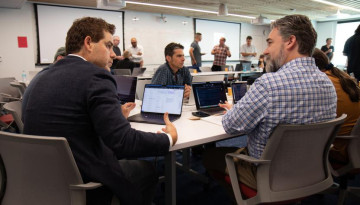
Thirty participants from 23 units across eight colleges gathered in early August to explore what an AI-enabled future of software development might look like at Cornell. They expected to share tools, compare approaches, and test new ideas. Instead, many left talking about something else entirely: people.
Cornell’s To Do the Greatest Good campaign surpassed its goal of raising more than $5 billion and engaging more than 200,000 alumni – achievements that will enhance opportunities for students and accelerate critical faculty research.
Seven Cornell research teams have received Center for Advanced Technology grants to advance early-stage life science technologies through collaborations with biotechnology companies across New York state.
This summer, 60 undergraduates participated in the Bowers Undergraduate Research Experience, a 10-week, paid program where undergraduate students do real-world research alongside Bowers faculty.